

The Ten Mahavidhyas: The Forces That Break and Rebuild Us
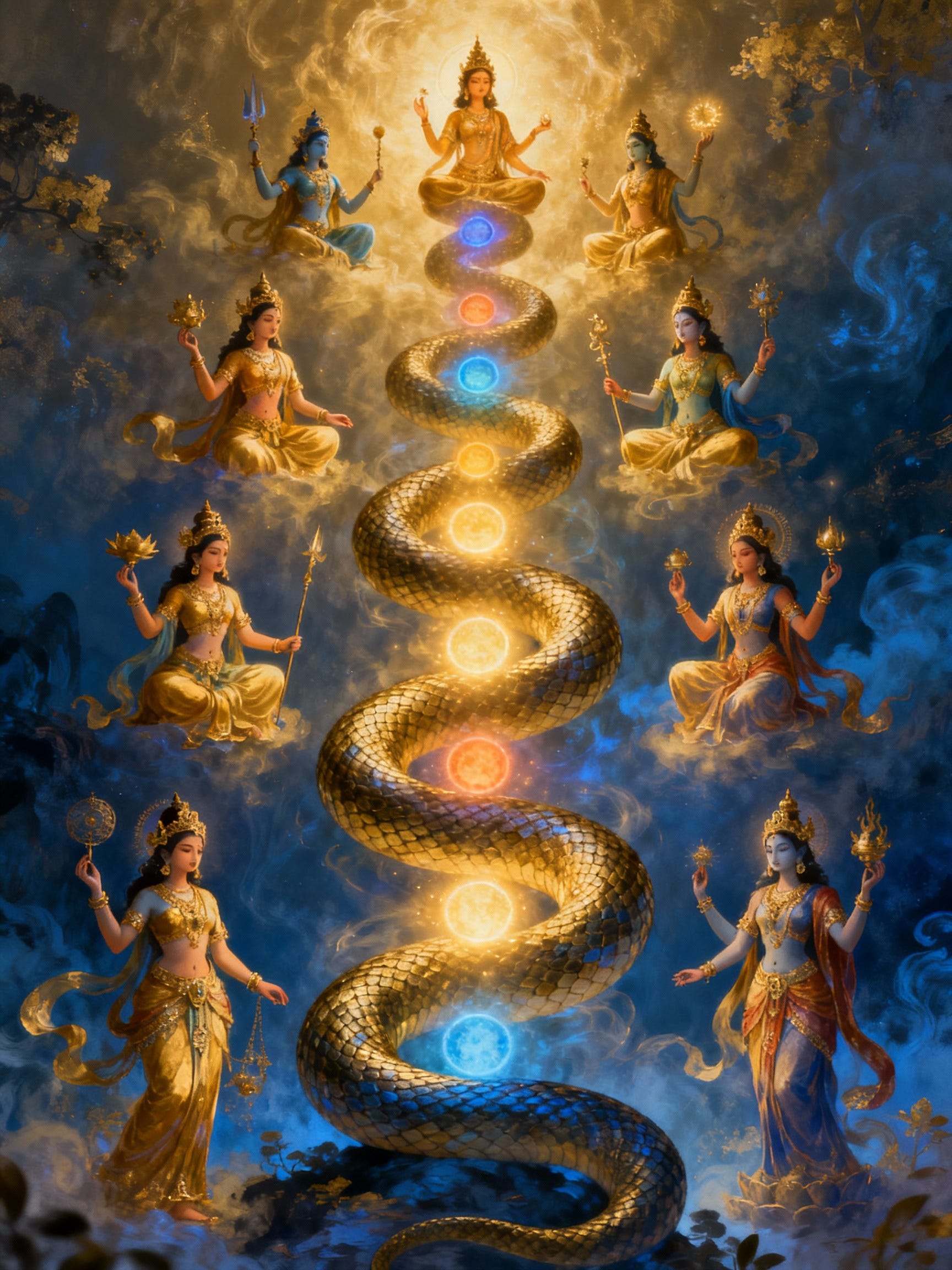
Three gunas, two approaches, and ten forms — all pointing back to one consciousness.

△ Infinite Awakening | By Beyond Coordinates
Readers Note
This is not a religious guide or a mythological retelling.
This piece explores the Ten Mahavidyas as symbolic maps of consciousness. Each represents a force that breaks illusion, challenges comfort, or expands awareness.
No prior knowledge is required. Read this as an inquiry into how ancient systems understood power, fear, time, and transformation long before modern frameworks tried to name them.
Teaser
I’m not a scholar. I’m not trying to explain Tantra in a grand way.
I’m just trying to write down what I understood so far — in a simple, human way — about the Mahavidhyas and why they feel like ten different states inside me, not ten separate goddesses.
Prologue — Where This Curiosity Started
My interest in the Mahavidyas didn’t come from temples or rituals.
It came from a strange curiosity about my own mind.
Some days I feel calm.
Some days restless.
Sometimes I face things directly, sometimes I avoid them.
And I always wondered why the mind behaves in such extremes.
When I first read about the Mahavidhyas, they didn’t feel mythical.
They felt psychological and heavily transformational. Almost like ten different reactions my awareness goes through when life becomes intense or uncertain.
Before understanding them, I needed to simplify how Tantra itself sees worship.
Not the complicated version… just the most basic structure that made sense to me.
Two Approaches to Worship
Most people think Tantra means “rituals” or “mantras.”
But it is much simpler than that.
1. Dakshinachara — the mainstream ritual path (not Tantric)
This is the clean, structured way of worship:
puja
mantras
offerings
satvik or rajsik rituals
It’s not the Tantric path.
It is the socially accepted, Puranic-influenced approach.
It matches the part of me that likes order, discipline, rules and cleanliness.
2. Vamachara — the actual Tantric path
This is where Tantra actually sits.
facing fear
facing discomfort
breaking conditioning
confronting shadow
sometimes cremation-ground practices
tamsik-rajsik transformation
It is not chaotic.
It is controlled, intense, direct.
And it matches the part of me that grows only when I stop avoiding my own truth.
The Three Qualities
Inside both approaches, I noticed three simple tendencies or gunas:
Satvik — clarity
Rajsik — movement or effort
Tamsik — intensity or confrontation
I felt these three qualities inside myself long before I read their names.
Different Mahavidhyas show different combinations of these energies.
Nothing more complex is needed for understanding.
A Small Note on Duality and Non-Duality
I don’t want to overthink this part.
Some Mahavidhyas work through contrast — fear and courage, emptiness and desire, chaos and stability. Others point toward a steady state where the mind stops dividing everything.
My own journey also feels like that.
First dealing with the scattered parts of myself.
Then slowly learning to hold everything without labelling it.
The Ten Mahavidhyas
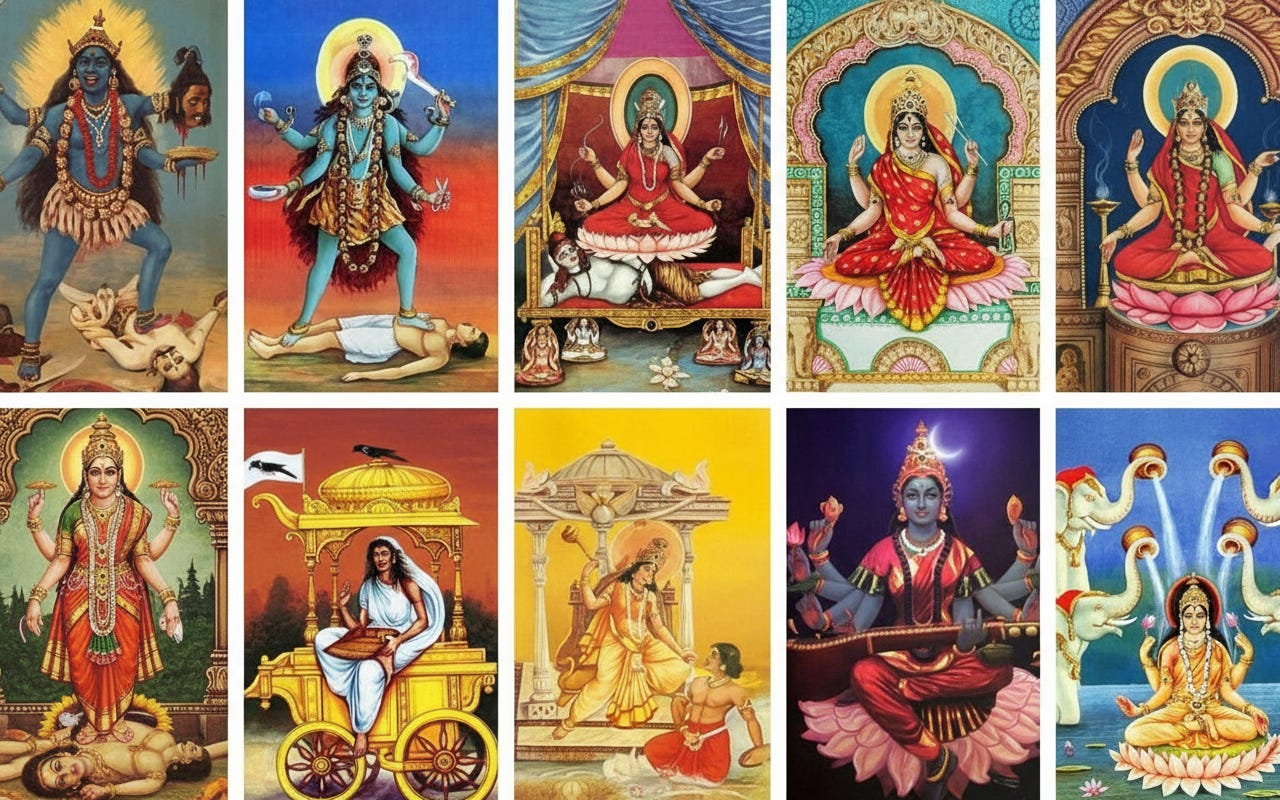
1. Mahakali
Consort: Mahakal
Essence: removing what blocks me or what is not meant for me or serve my purpose
Temple: Kalighat Temple — Kolkata, West Bengal
Kali has never felt like one form to me.
People experience her differently.
Bhadra Kali feels like protection, growth, stability.
Samshan Kali removes what is unnecessary, sometimes brutally.
Dakshina Kali makes me face the fears I avoid the most.
Guhya Kali feels hidden and inward.
Chamunda feels like raw strength.
Different moods of intensity, not different goddesses.
Meaning for me: she forces me to look honestly at things I delay/procrastinate or fear
2. Tara
Consort: Tar
Essence: guidance when I’m confused
Temple: Tara Ma Temple — Tarapith, West Bengal
Tara appears in forms that feel like different ways guidance shows up.
Neel Saraswati feels like clarity in speech and expression and knowledge.
Ugra Tara is sharp and almost like a shock that redirects me.
Ekajata protects in chaotic situations.
Tarini feels maternal and grounding.
I don’t see them as separate.
Just different expressions of direction.
Meaning: sometimes guidance arrives quietly, sometimes like a push.
3. Shodashi (Tripurasundari)
Consort: Shodash
Essence: alignment and inner balance
Temple: Kamakhya Temple — Guwahati, Assam
This is the Mahavidya I think about the most.
At Kamakhya, she is worshipped as the Yoni, not as a statue.
It is the symbolic form of creation and birth.
During Ambubachi Mela, the sanctum closes for three days and men are not allowed inside.
The entire temple honors the fertility cycle of the divine feminine.
I haven’t visited Kamakhya yet.
But almost every story I have heard — from strangers, friends, travellers — left an impression on me. Something about that place stays in the mind and soul.
Shodashi cannot be approached casually.
Her worship comes through Sri Vidya, her mantras, and the Sri Yantra.
In physical-form worship, she appears as:
Lalita Tripurasundari
Rajarajeshwari
Bala Tripurasundari
Different forms, but the principle is one — alignment.
Meaning: when I am aligned inside, life stops feeling heavy. It also depicts the most important and significant part of human birth —Creation. One cannot be happy or at peace until and unless they create starting from Procreation or Any form of creation like arts, music, literature, Philosophy, Invention, etc. as no amount of wealth or material possession cannot fulfil human soul’s desire or bring peace.
4. Bhuvaneshwari
Consort: Bhuvaneshwar
Essence: mental and emotional space
Temple: Bhuvaneshwari Temple — Amarkantak, Madhya Pradesh
Her forms feel like expansion.
Adi Bhuvaneshwari feels ancient and grounding.
Maha Bhuvaneshwari feels like a wider perspective.
Para Bhuvaneshwari feels like an inward spaciousness and healing.
Meaning: she reminds me I don’t always have to shrink myself.
5. Chinnamasta
Consort: Chinnamast
Essence: direct truth without cushioning
Temple: Chintpurni Temple — Una, Himachal Pradesh
Her forms feel like different intensities of truth.
Vajra Vairochani feels like a sudden awakening.
Dakini-Chinnamasta feels ego-cutting.
Varini-Chinnamasta feels like inner courage.
She is unpredictable but honest.
Meaning: truth arrives the way it wants, not the way I want.
6. Bhairavi
Consort: Bhairav
Essence: disciplined intensity
Temple: Tripura Bhairavi Temple — Tripura
Her forms feel like different ways discipline shows up.
Tripura Bhairavi is grounded intensity.
Kala Bhairavi dissolves inner resistance.
Sundara Bhairavi feels controlled and steady.
Meaning: intensity is useful when it’s stable, not reactive.
7. Dhumavati
Consort: Dhumawat (Shiva as void)
Essence: emptiness, silence
Temple: Dhumavati Temple — Varanasi, Uttar Pradesh
Dhumavati is mainly one form — the widow form, the alaksmi state.
She represents loss, silence, abandonment, and the wisdom hidden inside all that.
Traditionally, married people or grihasthas are discouraged from her direct upasana because her energy represents non-attachment and the void.
Meaning: emptiness is also a teacher, if I stop running from it.
8. Bagalamukhi
Consort: Bagalamukh
Essence: stopping harmful patterns
Temple: Bagalamukhi Temple — Datia, Madhya Pradesh
Bagalamukhi shows up in forms that feel like different ways of stopping chaos.
Stambhana — stopping harmful forces and winning over enemies
Peetambara — power in speech and intention.
Vishalakshi Bagala — clarity in conflict.
Meaning: stopping something at the right time is as powerful as starting something new.
9. Matangi
Consort: Matang
Essence: honest expression
Temple: Matangi traditions linked with Madurai, Tamil Nadu
Her forms feel like different kinds of expression.
Raja Matangi — clarity in communication.
Ucchishta Matangi — breaking taboos and rigid structures.
Sumukhi — guidance through speech.
Meaning: expression becomes healthier when it is honest, not reactive.
10. Kamalambika (Kamala)
Consort: Kamal
Essence: grounded prosperity
Temple: Kamala Peeth — West Bengal
Her forms feel like different layers of ease.
Sri Kamala — stability
Maha Kamala — inner abundance
Tantric Kamala — prosperity with awareness
Meaning: abundance is ease, not excess.
Epilogue — A Few Things I Learned While Writing This
One thing almost every lineage agrees on — proper initiation is necessary for real Mahavidya sadhana.
Especially in the Nath Sampradaya, Shakta traditions, Kaula practices and Sri Vidya lineages.
Not because of fear.
But because these energies are intense and need correct mantra, correct ritual, correct boundaries and correct guidance.
Everything I wrote here is only my internal understanding, not sadhana.
And one more thing I realised…
One lifetime is short to even understand one Mahavidya properly.
Let alone all ten.
They feel like ten different forms, but it’s one principle — one divine feminine — appearing through different lenses so that different people can grow in different ways.
Maybe the form we see depends on the lens we carry.
Maybe they meet us in the way we are able to understand them.
And maybe that’s enough for this lifetime.
“The Self is one, but appears as many.” — Upanishads
Human Work. Verified by RADAR & GLTR.
© Beyond Coordinates 2026