

The Material Layer That Connects Healthcare, Energy, and Electronics
How Specialty Chemicals Quietly Shape Healthcare, Energy, Electronics, and Infrastructure


△ ▼ △
The Expanding Orbit | By Beyond Coordinates
Matter commits.
Industries adapt.
Societies inherit the consequences.
Readers Note
This Expanding Orbit essay examines how specialty chemicals operate beneath multiple industries at once, from healthcare and energy to electronics, automotive, and infrastructure. It explores how upstream material decisions shape enterprise strategy, manufacturing scale, and long term industrial competitiveness.
It is written for operators, product leaders, industrial strategists, and enterprise decision makers who understand that material choices made early often determine outcomes decades later.
If you operate in manufacturing, materials, AI hardware, or infrastructure strategy, this series goes deeper. Subscribe to stay with it.
Prologue — The Decisions That Precede Debate
When I look at how industrial conversations usually unfold, I notice they tend to start too late. We debate outcomes after products launch, after infrastructure is built, after systems are already in use. By then, the direction is set.
Long before that, quieter decisions are made — at the level of materials.
Specialty chemicals sit at that early threshold. I’m struck by how rarely they attract attention, even though they quietly define durability, safety, efficiency, and failure modes across industries. Once chosen, these materials are difficult to replace and even harder to reverse.
That’s why, for me, specialty chemicals matter beyond chemistry or manufacturing. They are one of the last industrial layers where human judgment commits societies to long-term paths — often without visibility, and long before consequences become measurable.
Seeing Specialty Chemicals Without Industry Language
I’ve found it’s easier to understand specialty chemicals without categories or jargon.
They show up wherever something needs to behave precisely under pressure:
Strong without becoming heavy
Flexible without failing
Stable across time, heat, or moisture
Safe when embedded deep inside other systems
What stands out to me is that these materials aren’t general-purpose. They’re designed for specific outcomes, in specific environments, with little tolerance for error. They’re qualified slowly, trusted cautiously, and changed reluctantly.
Once embedded at scale, they quietly set limits on what becomes possible later.
Where Industries Begin to Overlap
One pattern I keep seeing is that specialty chemicals rarely belong to a single sector. They move through adjacency, borrowing logic from one industry and carrying it into another.
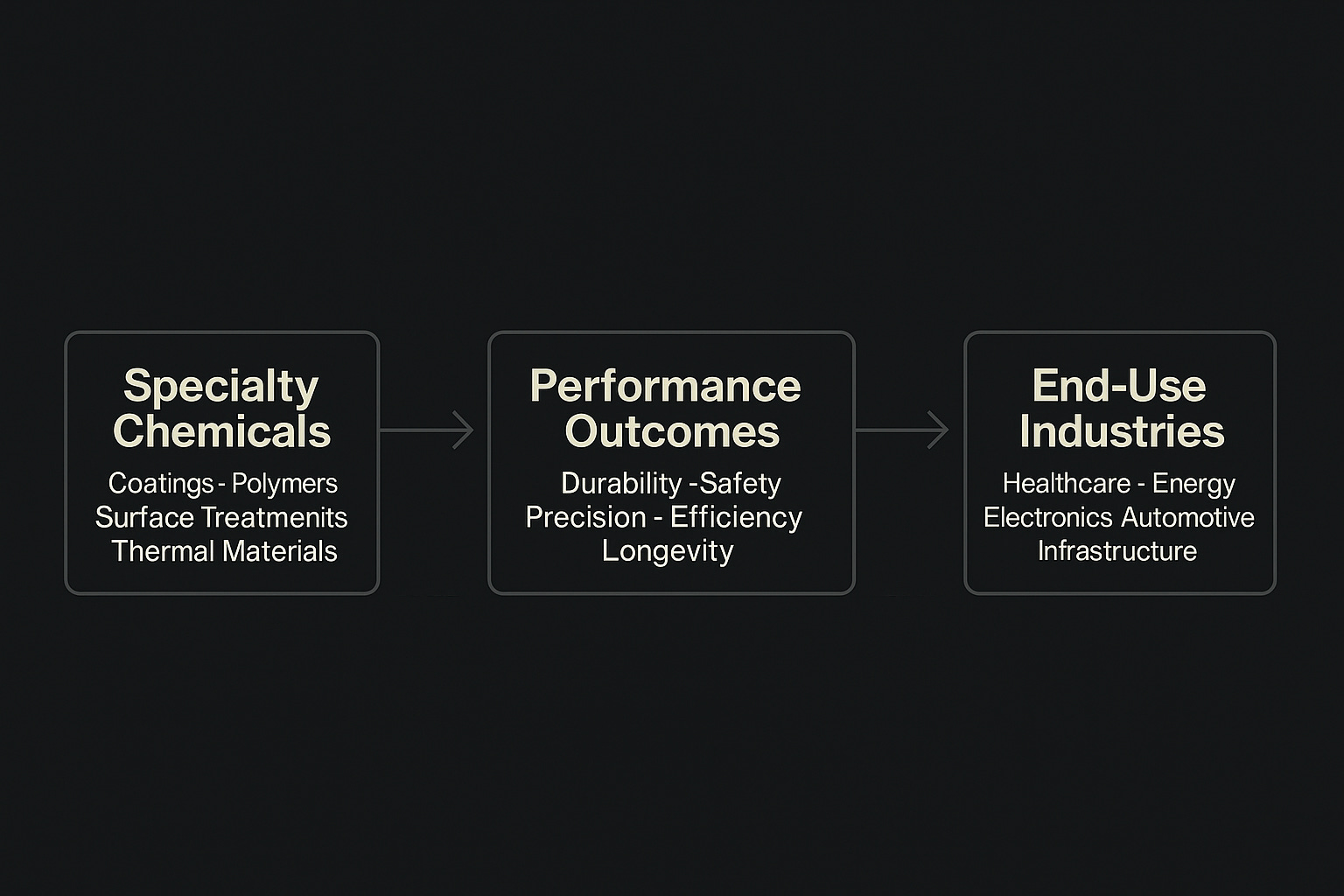
How specialty chemicals translate into industrial outcomes
Healthcare ↔ Manufacturing
I’ve noticed that materials originally developed for industrial endurance increasingly define medical reliability:
Anti-corrosion coatings protecting surgical instruments
Advanced polymers enabling flexible implants
Surface treatments reducing infection risk
Here, material choice decides not just performance, but how failure occurs — sudden or gradual, detectable or silent. It’s telling that nearly 25% of medical device recalls trace back to material or coating failure rather than design intent.
Automotive ↔ Energy
What strikes me is how automotive efficiency work has quietly shaped energy systems:
Lightweight composites improving vehicle range
Heat-resistant materials migrating from engines to batteries
Adhesives replacing mechanical fasteners to reduce vibration and weight
In electric vehicles, materials alone contribute 15–20% efficiency gains through weight reduction and thermal management. These aren’t marginal improvements — they shape reliability over time.
Electronics ↔ Precision Chemistry
Semiconductors are often discussed as a software or computing story. I’ve come to see them as a materials story first.
Ultra-pure chemicals enable precise fabrication. Etching and cleaning agents determine yield. Insulating resins manage heat and long-term stability. More than 70% of yield losses in advanced chip manufacturing link back to material purity and chemical process variation, not design.
Here, chemistry quietly sets the ceiling.
Construction ↔ Long-Term Resilience
When I look at modern infrastructure, I see a shift away from simply bearing load toward surviving time.
Self-healing coatings extend asset life. Protective layers resist moisture, corrosion, and heat. Advanced materials can extend infrastructure lifespans by 30–50%, fundamentally altering public maintenance economics.
These choices decide whether infrastructure becomes a durable asset or a recurring liability.
The Point Most People Never See
What connects all these intersections is something I think we rarely acknowledge:
Material decisions are largely irreversible.
Software can be updated. Policies can be amended. Supply chains can be rerouted. But once a formulation is deployed at scale, societies inherit its maintenance cycles, safety margins, and exposure pathways for decades.
This is where specialty chemicals matter most to me — they’re where modern industry commits to a future path long before public debate even begins.
How Use Cases Travel Quietly
One dynamic I find consistently underestimated is use-case migration.
A coating designed for aerospace durability later appears in automotive paint. A polymer developed for medical flexibility finds its way into consumer electronics. A 3D-printing material tested in prototyping ends up in custom implants.
This rarely looks like disruption. It looks like adaptation — suppliers adjusting formulations, knowledge transferring quietly, and solutions becoming foundational almost unnoticed.
That’s how specialty chemicals scale.
Manufacturing as the Real Constraint
Across all these intersections, I keep coming back to the same constraint: manufacturing, not chemistry.
Scaling a specialty chemical demands consistency, safety, qualification across industries, and compliance across regulatory regimes. A formulation approved for electronics may take years to qualify for healthcare. One stable in automotive may fail pharmaceutical standards.
This friction slows adoption, but it also preserves trust. It’s the tension that defines the industry.
Understanding the Landscape by Role, Not Rank
Instead of leaders and challengers, I find it more useful to look at how different players behave and where value actually sits.
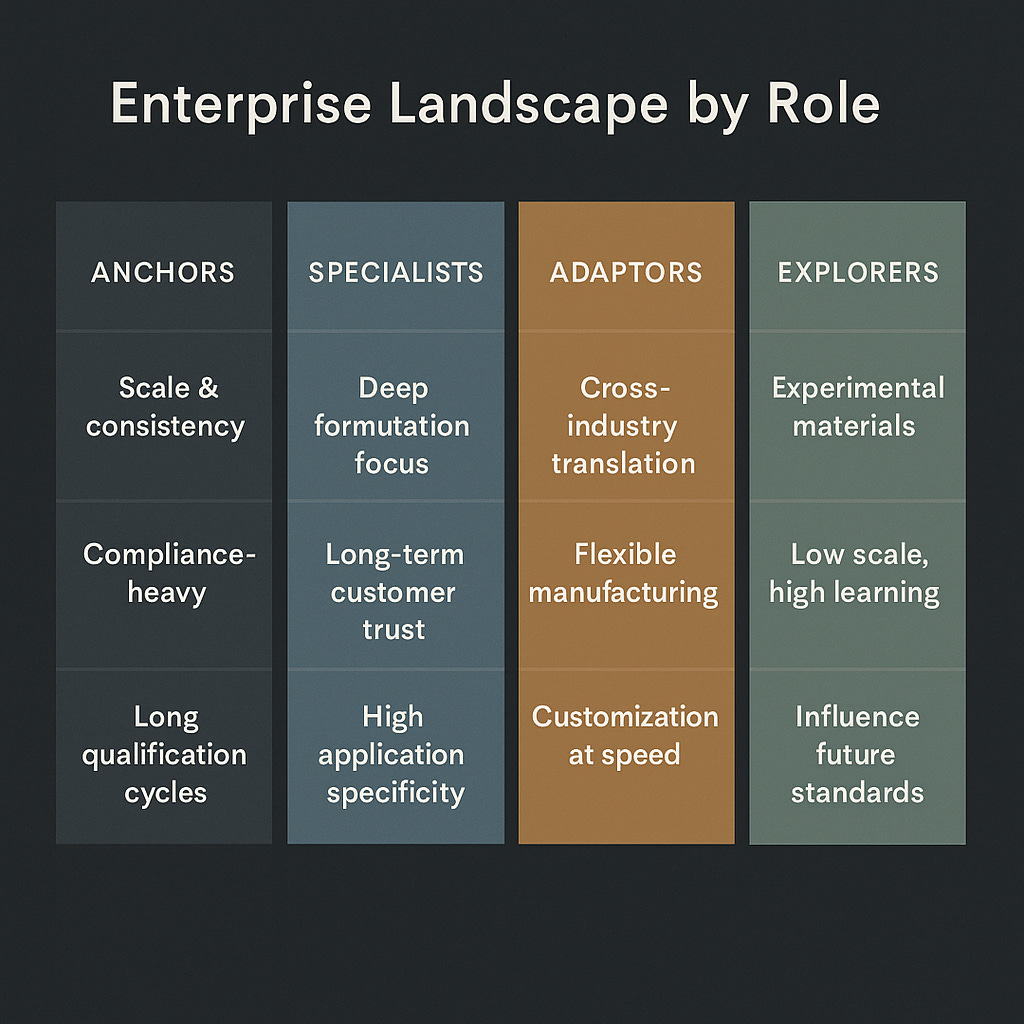
The specialty chemicals ecosystem, viewed by enterprise role
Anchors — the stability layer
Trusted when failure is not an option
Invest heavily in safety testing, compliance, and consistency
Typically operate with long qualification cycles and low churn
Data point: Anchor players account for ~50–60% of specialty chemical revenues, but grow slower than the market due to regulatory and qualification lock-ins (McKinsey)
Example: A supplier whose coating chemistry remains unchanged for decades because healthcare and infrastructure systems depend on its predictability.
Specialists — the knowledge layer
Deeply focused on narrow formulations or use cases
Work with customers over multi-year product lifecycles
High margins driven by application expertise, not volume
Data point: Specialty-focused mid-tier firms often generate 2–3× higher EBITDA margins than commodity chemical producers (BCG)
Example: A mid-sized firm refining a single polymer formulation across multiple generations of medical devices.
Adaptors — the bridge layer
Translate materials from one industry into another
Modify formulations to meet new environments and regulations
Absorb volatility across sectors rather than dominate one
Data point: Over 30% of specialty chemical revenue growth now comes from cross-industry application reuse (BCG, industry surveys)
Example: A manufacturer adapting an aerospace-grade coating for electric vehicle battery housings.
Explorers — the edge layer
Experiment with new materials, inputs, and processes
Low success rates, but high long-term influence
Often inform future standards rather than current markets
Data point: Less than 10–15% of experimental specialty materials ever reach commercial scale, but those that do often define new regulatory baselines (OECD, WEF)
Example: A small lab developing bio-based alternatives that later influence industry-wide safety benchmarks.
No single group controls the industry.
The system functions because all four coexist under constant pressure.
Why Geography Still Matters
What’s easy to miss is how physically rooted this industry remains.
Specialty chemicals depend on skilled labor, water availability, energy access, and regulatory infrastructure
Manufacturing clusters emerge where these factors have accumulated over decades
Proximity to customers reduces qualification time and operational risk
Data points that matter:
Over 70% of specialty chemical manufacturing capacity is concentrated in fewer than 10 global industrial regions (OECD)
Relocating a specialty chemical process can take 3–7 years due to requalification, regulatory approval, and customer validation (McKinsey)
That concentration brings efficiency — and dependency.
Rebuilding production elsewhere isn’t just capital-intensive
It requires recreating tacit knowledge, retraining teams, and restoring customer trust
Example: A formulation may take months to reproduce at a new site, but years before customers approve it for mission-critical use.
What This Industry Reveals About the Next Phase of Industry
When I step back, what stands out to me is how this industry previews the future of many others.
Industries are becoming less standalone, more interdependent, and increasingly shaped by decisions made far upstream. Specialty chemicals reveal how progress now depends on layers that operate out of sight, committing outcomes long before results are visible.
Epilogue — What Follows Commitment
I’ve deliberately focused this piece on intersection and use, not on environmental or social impact.
But I don’t think those dimensions can stay in the background much longer. As material lifecycles lengthen and manufacturing density increases, sustainability, regulation, and human exposure stop being abstract ideas and become lived realities.
Those forces deserve their own examination , directly and without dilution.
This essay lays the industrial groundwork. What follows, in future pieces, is how these material decisions intersect with sustainability, regulation, and long term systemic risk.
Sources
McKinsey & Company — The Future of Specialty Chemicals
Boston Consulting Group — Value Creation in Specialty Chemical Markets
SEMI — Semiconductor Materials & Manufacturing Reports
International Energy Agency — EV Materials & Efficiency Studies
U.S. FDA — Medical Device Recall Database
World Economic Forum — Infrastructure Longevity & Materials Research
OECD — Industrial Chemicals and Manufacturing Geography
© Beyond Coordinates, 2026
All rights reserved. This work reflects original analysis and authorship.
Human written. Verified via Radar and GLTR.
Beyond Coordinates studies how upstream industrial decisions shape enterprise strategy, AI infrastructure, supply chains, and long term economic structure.
For collaboration or advisory conversations, reach out at
jagrut.beyondcoordinates@gmail.com