

The Five Faces of Shiva — The Geometry of Consciousness
When Awareness Learns to Face Itself


△
Infinite Awakening | By Beyond Coordinates
There are forms that invite faith — and then there are forms that reveal patterns.
The Shivlingam, to me, has always belonged to the latter.
I don’t see it as a symbol of worship.
I see it as a map — the meeting of space and consciousness, matter and awareness.
It’s the simplest form that carries the greatest secret: how stillness shapes the moving world.
The circular base grounds it, the vertical form rises from it, and the invisible point above it — that’s the fifth, unseen direction.
It’s where motion ends and awareness begins.
And perhaps that’s what the Five-Faced Shiva (Panchmukhi) really is — not a deity looking five ways, but consciousness observing itself from every direction it exists.
The Geometry of the Five
I think of it like this — four directions carry life outward, and one carries it home.
The four directions — east, west, north, and south — represent expansion, experience, and expression.
The fifth, rising upward, is not a place — it’s a realization.
Together, they form the sacred geometry that the Shivling embodies: the eternal cycle below and the ascension of awareness above.
It’s the reminder that everything which moves must one day become still —
and everything that becomes still begins to see.
The Five Faces of Shiva — Decoding Panchmukh as Direction of Awareness
Each face of Shiva is not just a direction in space, but a movement within consciousness.
I feel each one lives quietly within us — shaping the way we breathe, act, and awaken.
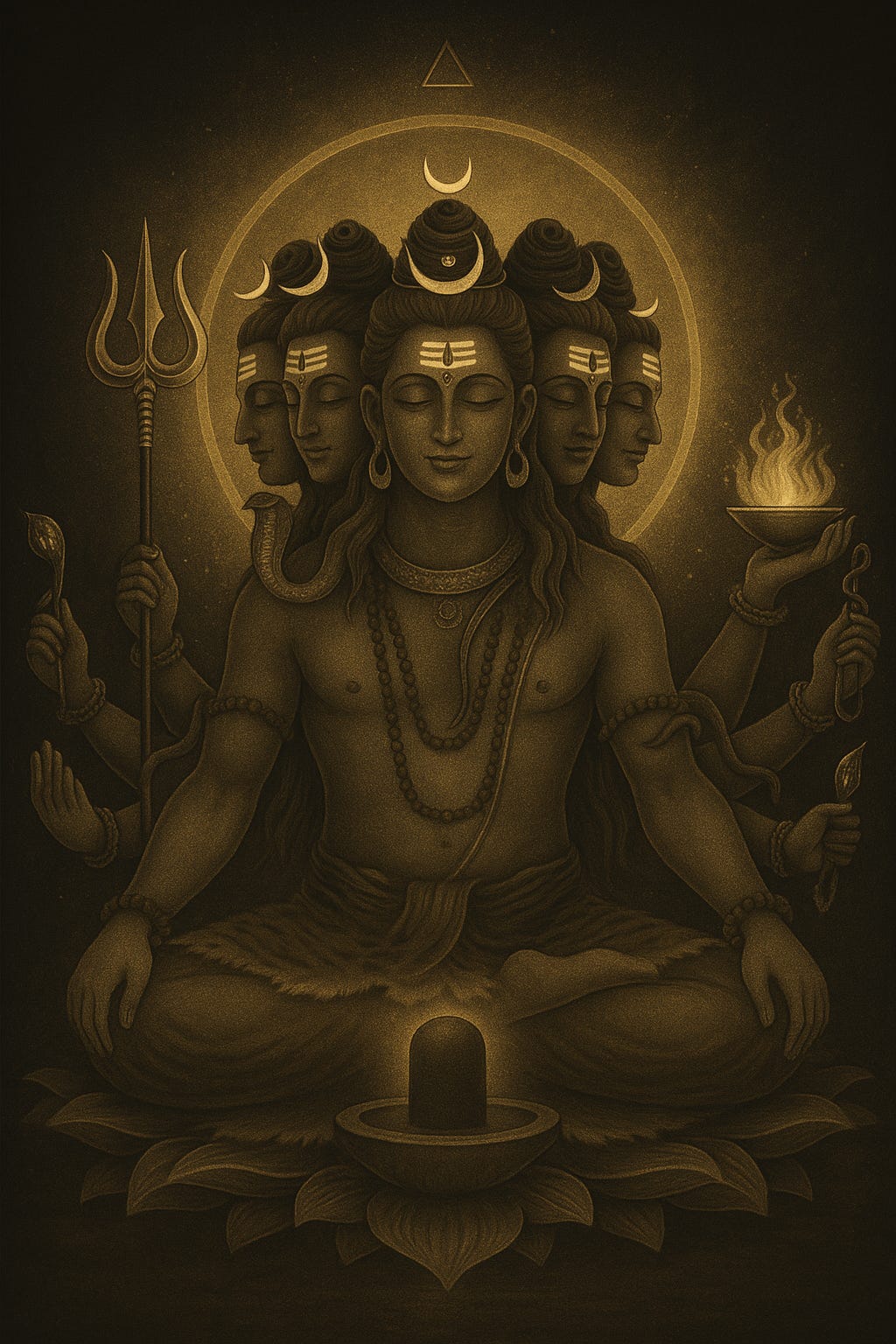
Tatpurush (East) — The Face of Emergence
The moment awareness says “I am.”
It’s the light that births individuality — the first dawn of self.
I think of it as the courage to be — to step into identity while still knowing it’s temporary.
Emergence — where silence decides to speak.
Aghor (South) — The Face of Transformation
The purifier, the dissolver of what no longer serves.
It’s not violence, but mercy — the mercy of truth stripping away illusion.
I feel Aghor is the fire within us that burns only to reveal clarity.
Transformation — endings as new beginnings.
Vamadev (North) — The Face of Harmony
The one that sustains, nurtures, and preserves.
It’s the balance between doing and being.
I think of it as the breath between two heartbeats — gentle, invisible, yet essential.
Harmony — holding the world without holding onto it.
Sadhyojat (West) — The Face of Manifestation
The spark that becomes form, the unmanifest made visible.
It’s the creative joy of existence expressing itself through you.
I feel it’s the whisper that turns into music, the thought that becomes a world.
Manifestation — creation as play, not purpose.
Ishan (Zenith) — The Face Beyond Faces
The silent witness, the center of all directions.
It is awareness aware of itself — no beginning, no boundary.
I believe Ishan is what remains when everything else is gone.
Transcendence — stillness without absence.
The Five Elements Within
The faces of Shiva also breathe through the five elements of the human body and the universe itself.
They are not metaphors — they are the anatomy of awareness.
Sadhyojat — Earth — the structure, bones, and stability within us.
Vamadev — Water — the emotions, flow, and adaptability.
Aghor — Fire — the will, transformation, and digestion of experience.
Tatpurush — Air — the movement of breath and life-force.
Ishan — Space — the infinite space where awareness rests.
I feel this is where mythology becomes biology — the same consciousness that holds galaxies also holds our breath.
How It Differs from Common Forms
Most forms of Shiva are intimate — one face, one energy, one emotion. They reflect relationship — a human seeking the divine.
But the Five-Faced Shiva reflects realization — the divine discovering itself through the human.
A single-faced Shiva teaches devotion — how to surrender.
The five-faced Shiva teaches awareness — how to expand.
One leads us to love; the other leads us to understanding.
I think both are necessary.
We begin with devotion — with Vishnu, the vastness that carries us through the worlds of experience.
And we end with Shiva — the stillness that receives us when the journey is done.
Yet, perhaps they were never separate.
Vishnu’s Vastness and Shiva’s Stillness are not two paths — they are two movements of the same breath. One expands outward, creating worlds; the other contracts inward, dissolving them back into awareness.
They complete each other — Vastness needs Stillness to be infinite, and Stillness needs Vastness to be known. The seeker walks between them until he realizes he was never walking at all — only remembering the rhythm of both.
Shiv Aahavan Mantra Strotram- Video Courtesy Religious India
The Significant Temples symbolizing this awareness
I often feel ancient temples were not built just to house deities — they were built to teach geometry through stone.
Kailasanathar Temple, Kanchipuram: Its spatial design mirrors the five-faced geometry — four directional shrines surrounding a central sanctum that opens upward to the Ishan principle.
Pancha Bhoota Sthalams:
Thillai Nataraja Temple (Chidambaram, Tamil Nadu) — Space
Ekambareswarar Temple(Kanchipuram, Tamil Nadu) — Earth
Jambukeswarar Temple(Thiruvanaikaval, Tamil Nadu) — Water
Arunachaleswarar Temple(Tiruvannamalai, Tamil Nadu) — Fire
Srikalahasti Temple (Andhra Pradesh) — Air
Each of these isn’t just a temple — it’s a point in the body of the subcontinent, aligning the five elements with the five faces of consciousness.
The Fifth Direction — The Ascent Within
I’ve come to believe the fifth direction doesn’t point upward at all — it points inward.
It’s the axis of awareness that runs through every living being.
When creation, preservation, transformation, and individuality align, something opens inside — a quiet corridor that leads home.
That’s Ishan. That’s the still point around which every motion spins.
It’s what Shiva represents — stillness itself.
Vishnu, in his vastness, moves through all the worlds, sustaining them with rhythm and grace.
But Shiva waits — in silence — not as an end, but as a return.
The journey, or perhaps the remembrance, was never from one god to another,
but from vastness to stillness, and also from stillness back into vastness — a circular breath that never ends.
One holds the movement of creation; the other holds the space it moves through.
And maybe, between the two, the whole universe keeps its balance.
Closing Reflection
“When the winds have all spoken,
and the fires have all sung,
what remains is the quiet face —
watching, within and without.”
I think every seeker becomes this geometry one day —
the body as the circle, the spine as the axis, and the mind as the sky opening toward Ishan
We begin as wanderers in the Vastness,
and end as silence in the Stillness.
And somewhere between the two —
perhaps, they were never different at all.
© Beyond Coordinates 2025