

The As-a-Service Model: Future of work
How modern work is turning into a system of subscribed capabilities. (Cloud, automation, design, sustainability, GIS, & research)

△ ▼ △ Cognitive Index | By Beyond Coordinates
Cognitive Index 04
Teaser:
I’ve been noticing something for years now — almost every function that companies once guarded as internal expertise has turned into a capability you can subscribe to. It’s no longer about owning tools or teams. It’s about accessing systems that run continuously. And I feel this shift says something deeper about how work, responsibility, and enterprise structure are quietly changing.
Prologue
I’ve always believed that the structure of work reveals the structure of an economy. And right now, work is reorganizing itself in a way that feels both inevitable and under-discussed.
We used to define work by departments — operations, finance, design, research, sustainability. Today, it’s defined by capabilities you plug in when you need them. Infrastructure, automation, analytics, carbon intelligence, GIS, design, and even elements of judgment itself are becoming “services” instead of internal muscle.
I see this as the rise of an As-a-Service Civilization — a shift that quietly sets the stage for the next decade of AI, agentic systems, and global operating models.
The Core Stack: How Cloud Became the First Service Layer
Cloud started the shift without making a fuss about it. Infrastructure-as-a-Service turned computing into a utility. Platform-as-a-Service offered development environments that just worked. Software-as-a-Service normalized the idea of applications you never have to maintain. CPaaS made communication programmable. FaaS allowed code to run only when triggered.
What this unlocked:
faster build cycles without upfront cost
elastic operations that scale with demand
predictable, recurring costs
a mindset that capabilities don’t need to be owned
I’ve seen firsthand how cloud didn’t just change IT — it changed how companies think.
SaaS now makes up nearly 60% of total cloud spending.
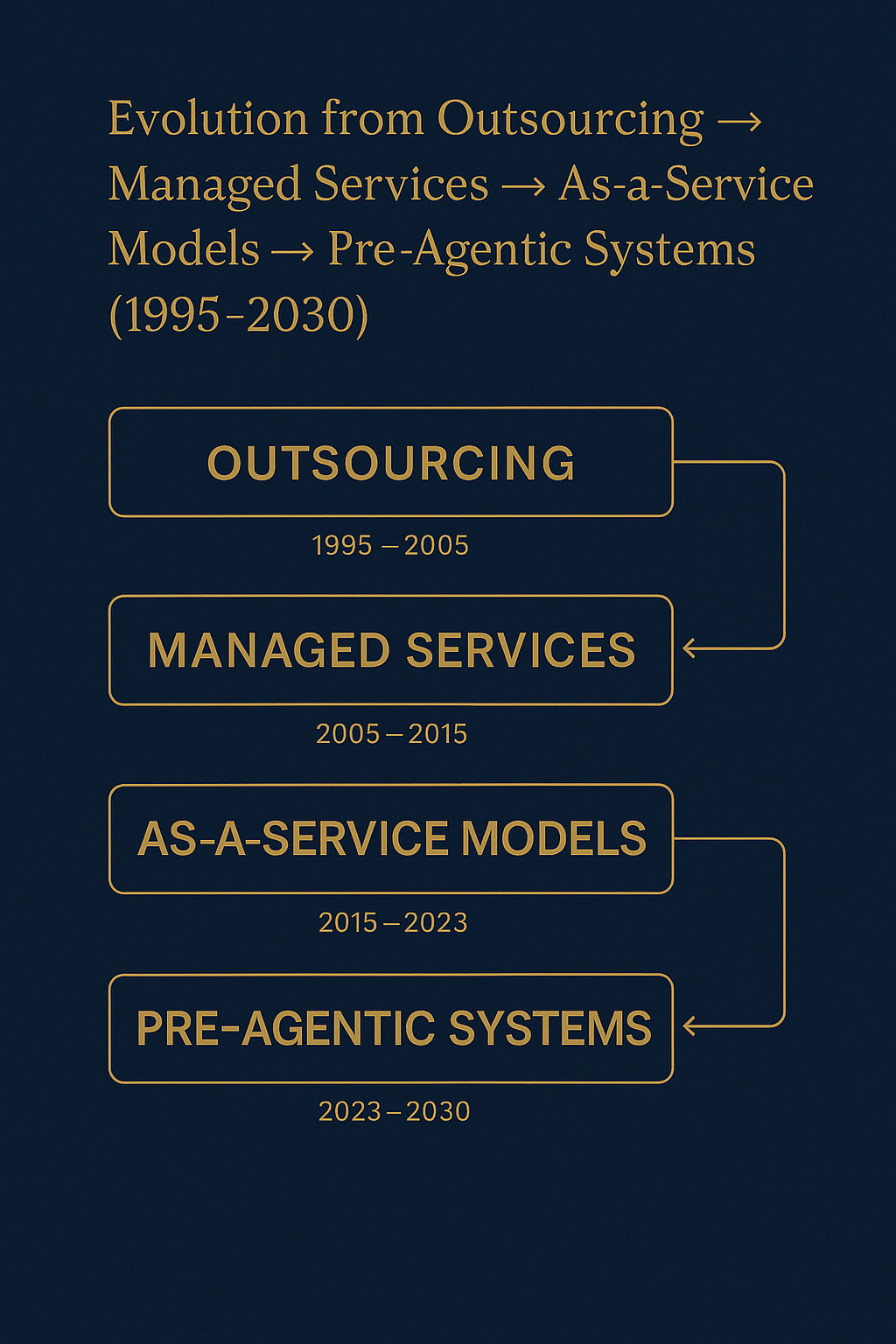
Infographic 1: Evolution from Outsourcing → Managed Services → As-a-Service Models → Pre-Agentic Systems (1995–2030).
Automation-as-a-Service: When Workflows Become Rented Behaviour
I’ve noticed companies gradually losing patience for building automation in-house. They don’t want to maintain scripts or workflow platforms anymore. They want outcomes. They want predictability. They want systems that don’t break when someone leaves the team.
Where this shows up the most:
onboarding and employee lifecycle flows
invoice and payout cycles
support routing and triage
compliance and identity checks
The idea is simple: rent the behaviour you need instead of building it yourself.
Nearly half of enterprise back-office activity already runs this way.
Intelligence-as-a-Service: Decisions Delivered on Demand
This is the layer that feels the most profound to me.
Companies used to guard analytics teams like strategic gold. Today many subscribe to intelligence instead of building it from scratch.
Capabilities I now see delivered as services:
churn prediction
fraud detection
demand forecasting
dynamic pricing
customer scoring and segmentation
This isn’t just outsourcing analytics — it’s renting judgment.
And whether we say it aloud or not, that’s a major shift.
Almost 70% of predictive workloads now run on managed ML platforms.
Process-as-a-Service: The Long Arc from Outsourcing to System Ownership
If we’re honest, India paved the early road for all of this.
What began as outsourcing eventually matured into full-fledged process capabilities.
The early templates for today’s Process-as-a-Service world:
Recruitment Process Outsourcing
Business Process Outsourcing & BPM
Legal Process Outsourcing
Finance & Accounting operations
These weren’t “support functions.”
They were global operating systems before we ever used that phrase.
Research-as-a-Service: Continuous Curiosity as a Capability
Research used to be episodic. You commissioned a report and waited.
Now it behaves more like a living signal — always running, always watching.
Companies now subscribe to:
competitor movement tracking
UX research cycles
product intelligence
category mapping
sector micro-trend scanning
Markets shift too fast for quarterly studies.
Curiosity has become something you rent continuously.
More than one-third of enterprise research budgets now flow into recurring subscriptions.
Design-as-a-Service: From Blueprints to Living Systems
Design has undergone one of the clearest and most dramatic transitions.
It’s no longer a “deliverable” — it’s an ongoing system you keep alive.
I see four layers here:
architecture & urban design that evolves with compliance, cost, mobility, and energy needs
3D CAD/CAM & industrial design that updates with materials, regulations, and engineering cycles
digital UX & product design that behaves like a rolling system
brand systems that stay alive instead of being reinvented every few years
Recurring design models have grown almost fivefold in the last five years.
Design has quietly become infrastructure.
Earth & Sustainability Intelligence-as-a-Service
This is easily the fastest-growing category — and the world hasn’t fully noticed it yet.
Core sustainability and Earth-intelligence systems delivered as services:
Carbon MRV (baselines, leakage, biomass, satellite audits)
Biodiversity intelligence (species, co-benefits, habitat health)
GIS/Remote Sensing (water stress, land-use change, soil carbon, climate risk)
ESG dashboards (Scope 1–3, GRI, CDP, SASB)
India has become the second-largest Earth-intelligence delivery hub globally.
Carbon, climate, and GIS capabilities get built here and deployed everywhere.
I’ve personally seen how quickly this space is expanding — almost month to month.
India’s GCC Rise: From Delivery to Global Decision Infrastructure
India’s evolution from outsourcing to GCC leadership is not an accident — it’s a continuation of the capability mindset.
Modern GCCs in India now run:
global payroll & onboarding
finance & supply chain analytics
ESG & sustainability systems
GIS pipelines
carbon intelligence
research engines
customer experience & marketing ops
full-stack AI/ML operations
These aren’t extensions of HQ.
They are the operating core.
India now hosts around 45% of the world’s GCCs, and the growth rate still feels unreal.
The Compression Ahead: AI, Agentic Systems, Edge, Quantum
This is where the As-a-Service world moves into its next phase.
What will compress everything:
agentic AI running workflows end-to-end
edge intelligence embedded into forests, farms, buildings, and factories
quantum systems collapsing simulation timelines
The concern I keep coming back to is this:
What happens when services begin to run themselves?
The real question becomes:
What do we automate, what do we supervise, and what do we choose not to delegate?
By 2030, most enterprise workflows may involve some form of agentic execution.
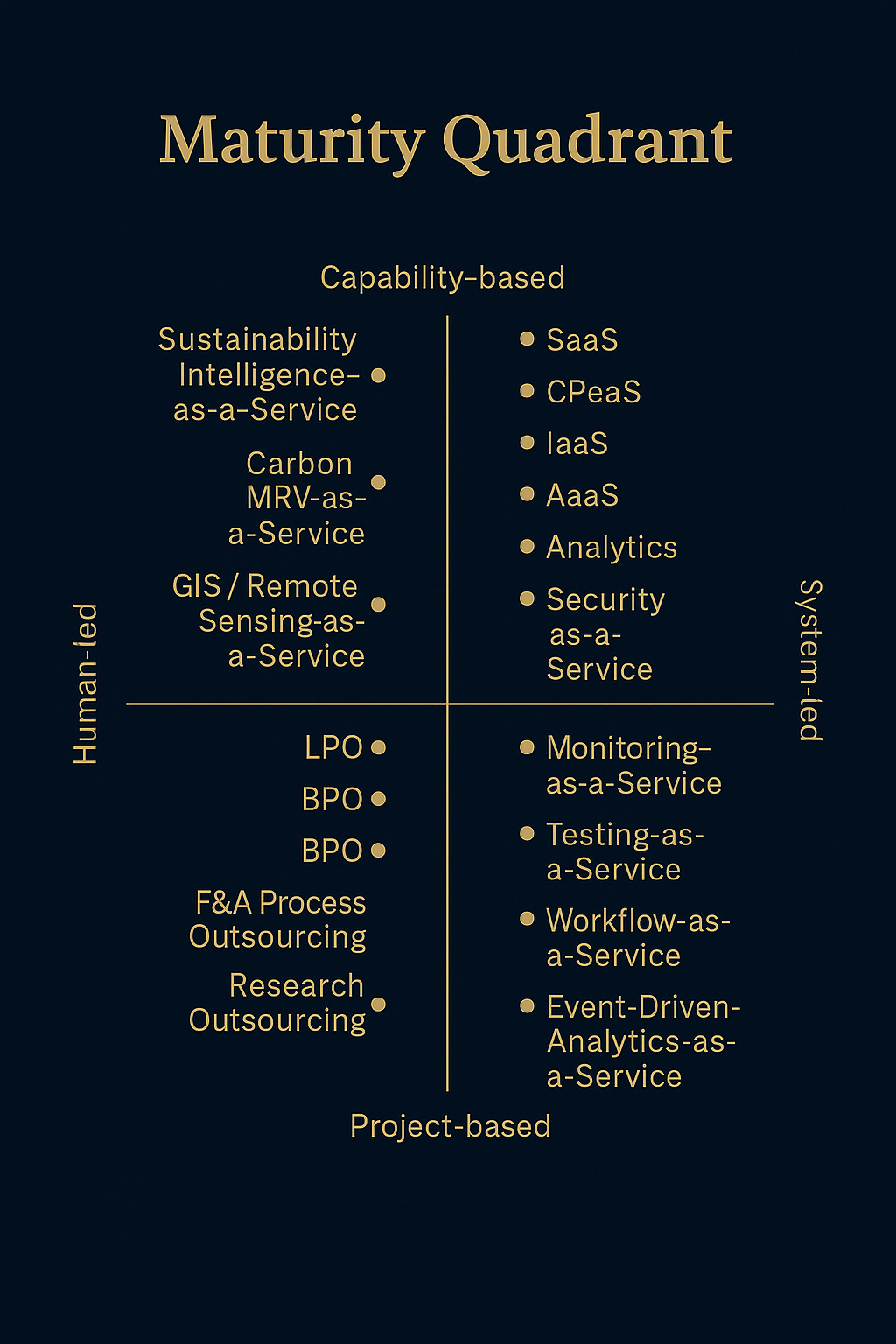
Maturity Quadrant mapping key as-a-Service models by leadership style (human-led vs system-led) and orientation (project-based vs capability-based).
Epilogue
The Future of Work
When I look at how work is evolving, one pattern feels increasingly clear: many roles that once lived inside organizations are slowly shifting toward independent, self-directed models. By the mid-2030s, we may see more self-employed professionals, fractional contributors, and micro-enterprise operators than traditional salaried workers. It won’t be a sudden shock — it will feel like a gradual rebalancing.
Early Signals Already Visible
Across industries, a new layer of independent capability specialists is emerging:
NLP coaches and micro-learning educators
UI/UX trainers and design mentors
Agentic-AI instructors and AI/ML Ops coaches
Cybersecurity freelancers
Prompt-engineering and workflow-automation trainers
Personal branding advisors and lead-gen studio founders
Mental-health micro-therapy and support practitioners
These aren’t side gigs — many of them are turning into sustainable, full-time careers.
Rise of Holistic & Alternative Learning Ecosystems
A parallel movement is happening in non-traditional learning spaces:
Yoga therapy
Ayurveda and wellness consulting
Mindfulness programs
Language and culture study
Astrology, Vastu, and energy-based planning
Cartography-inspired planning and spatial thinking workshops
These fields are becoming structured services with real demand and real income.
Fractional Roles Are Becoming Normal
More companies are choosing fractional specialists over full-time roles:
Fractional CMO
Fractional CFO
Fractional Chief of Staff
Fractional Head of Product
Fractional RevOps / GTM leaders
Fractional Design & UX strategists
This mirrors the As-a-Service model: access capability when needed, not permanently.
Work-from-Anywhere Is a Lifestyle Shift
Remote work is no longer a perk — it’s becoming a quality-of-life decision.
People increasingly prefer rural and peri-urban regions over dense cities.
Drivers include:
Rising cost of living
Poor air and water quality in cities
Declining mental health and increased burnout
Shrinking attention spans
Falling fertility rates
Desire for quiet, stable, nature-linked environments
AI makes this shift easier by reducing the need for physical proximity.
The Larger Transition
All of this points to a deeper movement:
→ Work is shifting from fixed employment to flexible, outcome-driven contribution.
→ Companies will access talent modularly.
→ Individuals will operate as self-contained capability units.
And at that point, the As-a-Service model becomes more than a business structure —
it becomes a social structure: a way people, skills, and systems connect without permanent walls.
The Real Question for the 2030s
It’s not whether AI will replace jobs.
It’s how people remain central when work becomes:
fluid,
distributed,
capability-first,
and outcome-driven.
AI can automate tasks — but not judgment, intent, interpretation, lived experience, and human meaning.
Those will define the strongest professionals of the 2030s.
I genuinely believe India’s early process maturity made the later As-a-Service explosion possible.
Today, the country handles nearly 50% of global structured back-office workflows.
▲ Human Work | Verified via Radar
Sources
Cloud & SaaS adoption trends
Global GCC research (India-focused)
Automation & workflow adoption studies
ESG, GIS & carbon intelligence talent data
Very insightful article!👏🏻👏🏻👏🏻