
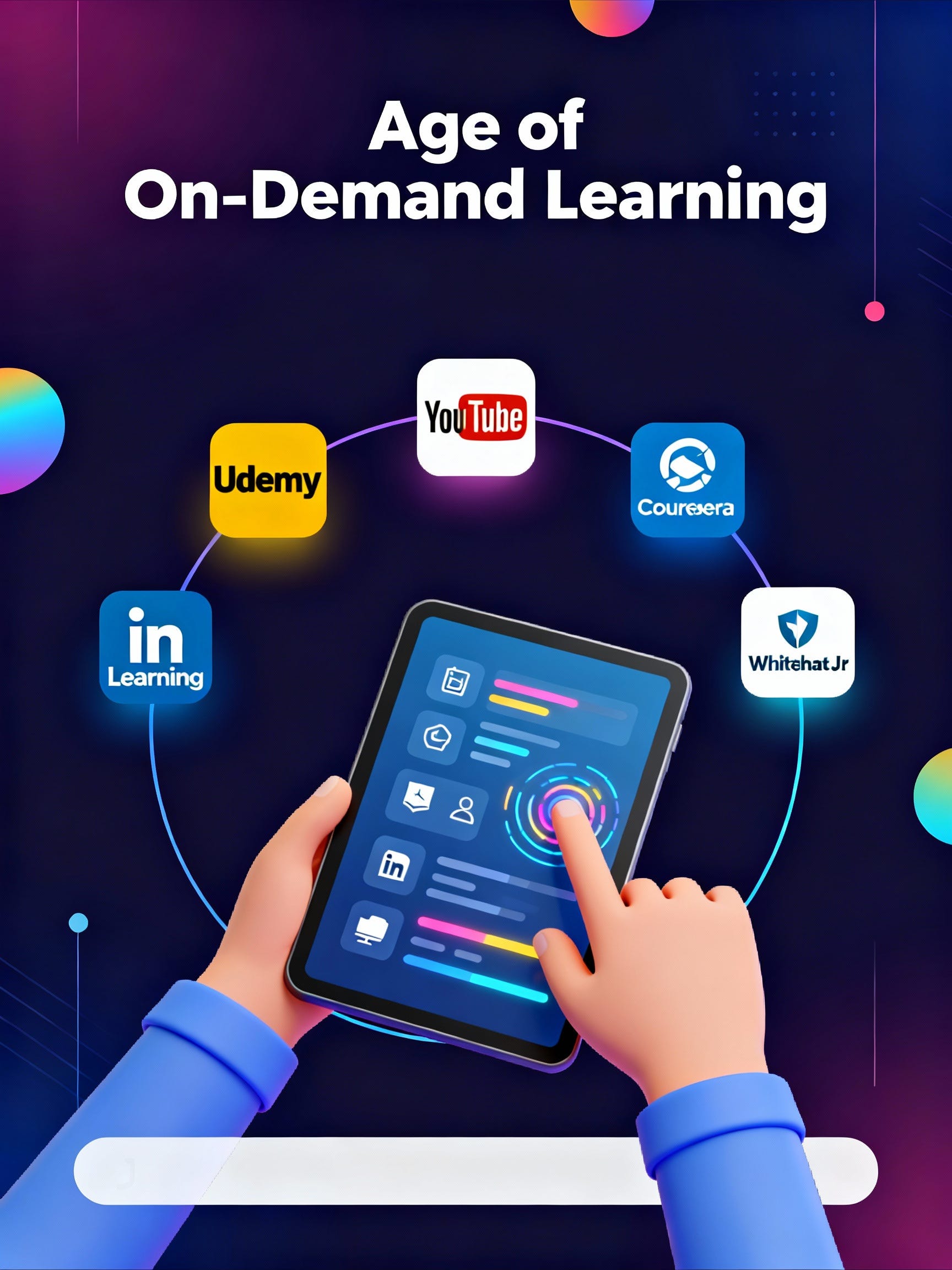
The Age of On-Demand Learning: Why Skills Are Replacing Degrees Now
How Gen Z, Millennials, and Working Professionals Are Rewiring Education Through YouTube, Micro-Courses & Real-World Skills

▲ ▷ ▽
Dispatches | By Beyond Coordinates
Teaser
Degrees once promised destiny. But in a world shaped by YouTube University, micro-learning, low-code tools, and skill-first hiring, the real shift is happening far outside classrooms. Here’s why 16–40 year old’s are learning faster, switching careers quicker, and treating the internet as their new university.
The Age of On-Demand Learning — When Skills Replace Degrees
For most of my childhood, a degree felt like destiny. It was the ticket, the shield, the social proof. Parents repeated it like scripture: “Study well, get a degree, your life will be sorted.”
But today, when I look around, I feel that sentence slowly dissolving. The world outside the classroom is compounding faster than the institutions inside it. And somewhere in the middle, millions of people aged 16 to 40 are navigating two timelines — the one their parents trusted, and the one their browser now recommends.
I think the first crack appeared when companies stopped asking “Where did you study?” and quietly shifted to “Can you actually do this?”
That one question changed everything.
The Real On-Demand University: YouTube + Micro-Courses + Low-Code Tools
Let’s be honest:
The biggest university in the world is not Harvard.
It’s YouTube University.
Nearly half of YouTube’s users say they use it specifically to learn — from Excel to coding to language learning to design breakdowns. Young adults treat it as their default skill grid: short explainers, deep-dive playlists, peer creators, free bootcamps, and structured multi-hour lectures.
Alongside YouTube sits the “micro-learning stack”:
Coursera & Google Career Certificates
Udemy & Skillshare
Cloud labs, micro-projects, weekend workshops
No Code platforms (Webflow, Bubble, Glide)
Low-code tools expanding what beginners can build
The old model was:
4 years → maybe a job.
The new model is:
4 hours → a skill → a project → income.
I believe this shift happened because learning finally began to match the pace of the world.
Platforms like Coursera and LinkedIn Learning have exploded during this shift.
Coursera now has over 120 million learners globally, with the highest growth coming from the 18–25 segment, especially in data, UI/UX, cloud, and business analytics.
LinkedIn Learning’s own 2024 workplace report shows that 59% of hiring managers now prioritise skills over degrees, and the fastest-growing skills are AI literacy, digital marketing, cloud fundamentals, and product thinking.
Pre-COVID vs Post-COVID: The Surge That Broke the Monopoly
COVID didn’t start online learning — it just pushed it past the point of no return.
Massive surges in global online enrollments
Micro-courses becoming the default, not the alternative
Early-career professionals adopting certifications for job-switching
The stigma around non-degree learning evaporating
In India, the shift was even sharper. Platforms like Unacademy exploded during and after COVID, becoming one of the country’s biggest online learning ecosystems — from competitive exams to language skills to early job-readiness tracks.
But the most interesting trend emerged elsewhere…
Early-Skill Platforms for Kids (WhiteHat Jr., BYJU’S Coding, Cuemath)
This boom wasn’t just young adults — it began even earlier.
Platforms like WhiteHat Jr., BYJU’S coding programs, Cuemath, and Vedantu SuperKids pushed a new narrative:
coding, logic building, and computational thinking aren’t “extra” — they’re basic necessities for Gen Alpha.
Kids as young as 6, 7, and 8 were learning:
Scratch & block programming
Beginner Python logic
Robotics basics
Creative problem-solving
Pattern recognition
Mathematical reasoning
Whether one agreed with the marketing or not, these platforms did one powerful thing:
they made early cognitive skill-building mainstream and taught an entire generation to treat technology like a language, not a subject.
The ground shifted quietly — but permanently.
Who’s Learning Like This? (Age Segments & Patterns)
Teens (13–18):
YouTube + TikTok + Discord + ChatGPT
They learn everything: coding, languages, editing, fitness, finance, mental health, CPR.
Short-form learning is their native language.
Young Adults (18–25):
The heaviest users of MOOCs (Massive Open Online Course) globally.
They’re hedging their degrees — stacking skills in UI/UX, cloud, analytics, No Code, AI tools, automation.
This age group learns “just in time,” not “just in case.”
Professionals (25–40):
Using learning as a lever for:
promotions
salary jumps
migration
career switching
For them, micro-learning isn’t a trend — it’s a survival strategy.
I feel the younger you are, the less sacred the degree feels — and the more natural it is to learn from the internet.
When We Judge Gen Z & Gen Alpha, We Miss What They’re Quietly Building
We love to joke about Gen Z and Gen Alpha.
Their memes.
Their emojis.
Their matcha fixation.
Their chaotic humour.
Their short attention spans.
Their soft-aesthetic notebooks and mental-health diaries.
Their “idk lol” texting style.
But beneath all the humour, they’re quietly reshaping global education culture.
Here’s what their “quirks” actually represent:
Memes → Information compression
They summarise complex ideas in two images and six words.
This is pattern recognition — a core cognitive skill in the AI era.Emojis → Visual literacy
They communicate nuance and emotion faster than any generation before.
Visual semantics is becoming a real language.Matcha, skincare, wellness → Self-regulation
Not vanity — but burnout prevention.
They treat mental health as literacy.Short videos → High-speed pattern learning
Reels don’t shorten attention spans; they sharpen pattern detection,
making them fast tool-learners.Discord servers → Micro-learning pods
They don’t study alone — they study with global peers in real time.ChatGPT fluency → Co-learning with machines
They don’t fear AI — they collaborate with it.“I’ll learn it on YouTube” → Radical adaptability
This single line defines their learning philosophy.
Gen Z and Gen Alpha aren’t drifting away from education.
They’re rebuilding it — meme by meme, server by server, skill by skill.
The Rise of Experiential Learning — When Doing Becomes the Degree
If there’s one shift I feel more than anything, it’s this:
learning today is no longer about what you know — it’s about what you can show.
For Gen Z, Gen Alpha, and even 30-somethings switching careers, experience isn’t something that comes “after the course.”
It is the course.
This is why experiential learning exploded:
Live projects instead of long lectures
Internships at 18, freelancing at 19, startups at 20
No Code MVPs built in a weekend
Cloud labs where you deploy real servers, not diagrams
UX case studies built from real user flows
Video edits made for actual clients, not imaginary ones
AI tools integrated into workflows, not theory slides
In this new world, “learning” and “working” are no longer separate.
The boundary dissolved.
I think this is the biggest revolution in education —
we moved from syllabus → experience,
from rote → real,
from learning → doing,
and finally, to learning while doing.
Platforms caught up too:
Coursera now embeds hands-on labs.
LinkedIn Learning ties courses to role-specific challenges.
No Code and AI platforms let beginners build real-world products instantly.
Even teenagers run micro-agencies, edit podcasts, design logos, and handle paid gigs.
Experiential learning became the new legitimacy.
It’s the quiet truth hiring managers already know:
a project is louder than a certificate.
A portfolio is louder than a GPA.
And the person who learns by doing learns faster than the person waiting for permission.
This is the real heartbeat of the on-demand learning age.
Experience is no longer the outcome —
it’s the entry point.
The Freelance & Creator Economy: The Skills That Actually Pay
By 2024, nearly 47% of the global workforce earned through freelancing at some level — and the curve is still rising.
The most monetizable skills right now?
Digital marketing, SEO, performance ads
UI/UX, product design, Figma
Web development, low-code, No Code
Analytics, CRM, automation
Lead generation, outbound ops
Video editing, content, storytelling
Copywriting, personal branding, newsletters
These aren’t degree-based skills.
They are ecosystem skills — learned online, practiced online, sold online.
This is why I believe the “real curriculum” of the modern internet is shaped not by universities, but by YouTube creators, micro-course instructors, Discord communities, and working practitioners.
When Learning Becomes Infinite, Burnout Becomes Normal
There’s a psychological cost to this abundance.
When every skill is one click away, you constantly feel behind.
When everyone is posting wins, you feel like you’re losing.
When every new tool drops every week, the anxiety compounds.
I’ve seen people open ten courses and finish none.
I’ve seen 22-year-olds panic because their friends “already know UI/UX + Webflow + motion design.”
I’ve seen 30-year-olds juggling work, family, and three certifications — burning out quietly at 1 a.m.
Maybe that’s why I’m seeing a gentle return to depth:
deep reading clubs
offline Sundays
stationery journals
cohort-based learning circles
café learning pods
People don’t want less learning.
They want less chaos around learning.
So What Replaces the Old Blueprint?
Not one thing — but a smarter stack:
A basic degree
for signalling and safetyA living portfolio
GitHub, Behance, Notion case studies, Loom demosMicro-skills
updated every 6–12 monthsA community
Discord, WhatsApp, meetups — for sanityResilience
because burnout is now part of the education ecosystem
In a world that updates like an app, the real skill is staying human while continuously learning.
A Quiet Closing
Sometimes I sit with all this and ask myself:
What is the real “degree” of this age?
And what’s striking is that this shift isn’t Indian or American or European — it’s global.
A teenager in Delhi, a designer in Berlin, a coder in Shenzhen, a marketer in Austin —
they all follow the same on-demand learning arc: discover → learn → build → apply → evolve.
I think it won’t be a certificate.
I feel it will be a rhythm — the ability to unlearn and relearn without fear.
I believe the people who thrive will be the ones who stay curious and adaptable, even when the world feels overwhelming.
Because in the age of on-demand learning,
the curriculum is everywhere — and life is the final exam.
© Beyond Coordinates, 2026
This piece is human-written. Verified via Radar & GLTR analysis.
Sources
Udemy Global Skills Report & 2020–24 Online Learning Data
Google Career Certificates & Coursera Statistics
YouTube Learning Trends & Global User Behaviour Reports