

Silver Is Becoming a Strategic Constraint, Not Just a Market Story
Why prices, policy, and geopolitics are converging around one metal


Epigraph
Markets react quickly.
Material systems do not.
Δ ▽ ⧋
Dispatches | By Beyond Coordinates
The Signal That Made Me P0ause
I started paying closer attention to silver when its behavior stopped looking cyclical.
Between 2020 and 2024, silver largely moved within a broad range, volatile but contained. That changed sharply in late 2025 and early 2026. Prices surged, crossed previous ceilings, and became unusually unstable, with sharp rallies followed by abrupt corrections.
For me, that kind of price action usually signals pressure, not enthusiasm.
It suggested that silver was being pulled by something larger than trading sentiment.
Quantum Arc: One Pressure, Several Breakpoints
1. Industrial Demand Has Become Structural
Silver demand today is driven less by preference and more by necessity.
Roughly 15 percent of global silver consumption now comes from solar photovoltaics, with additional demand from electric vehicles, power electronics, data centers, and advanced manufacturing. These sectors are tied to national transition targets and infrastructure spending.
Silver is consumed in these applications. Much of it is not economically recoverable once deployed.
Industry estimates suggest the global silver market has experienced supply deficits for roughly five consecutive years, with demand consistently exceeding new mine supply.
Hook
When demand is linked to policy targets, it does not retreat easily.
2. Supply Is Structurally Slow
Silver supply cannot respond directly to higher prices.
Most silver is produced as a byproduct of copper, zinc, lead, aluminium, and titanium mining. That means output decisions are driven by other metals, not silver itself.
Recycling and efficiency improvements help at the margins, but they do not eliminate the gap. New supply takes years to develop.
This creates a persistent imbalance rather than a dramatic shortage, but persistence matters.
3. China, Opacity, and the Gatekeeping Effect
This is where geopolitics quietly enters the silver story.
Unlike gold, where reserves are visible and reported, silver stocks largely sit hidden inside industrial supply chains, commercial inventories, and refining networks. In that opacity, China’s role as a dominant refiner and consumer has taken on outsized strategic importance in market psychology.
China is central to global silver refining and is also one of the largest end users through solar manufacturing, electronics, and EV supply chains. Since early 2026, export licensing and industrial prioritization have tightened, not to ban silver exports, but to manage flow.
For global markets, this feels like gatekeeping. Physical silver still moves, but less freely. Availability becomes conditional rather than assumed.
Hook
Markets respond more to control of flow than to ownership itself.
To understand silver today, it helps to see how demand, supply, and policy sit on top of each other.
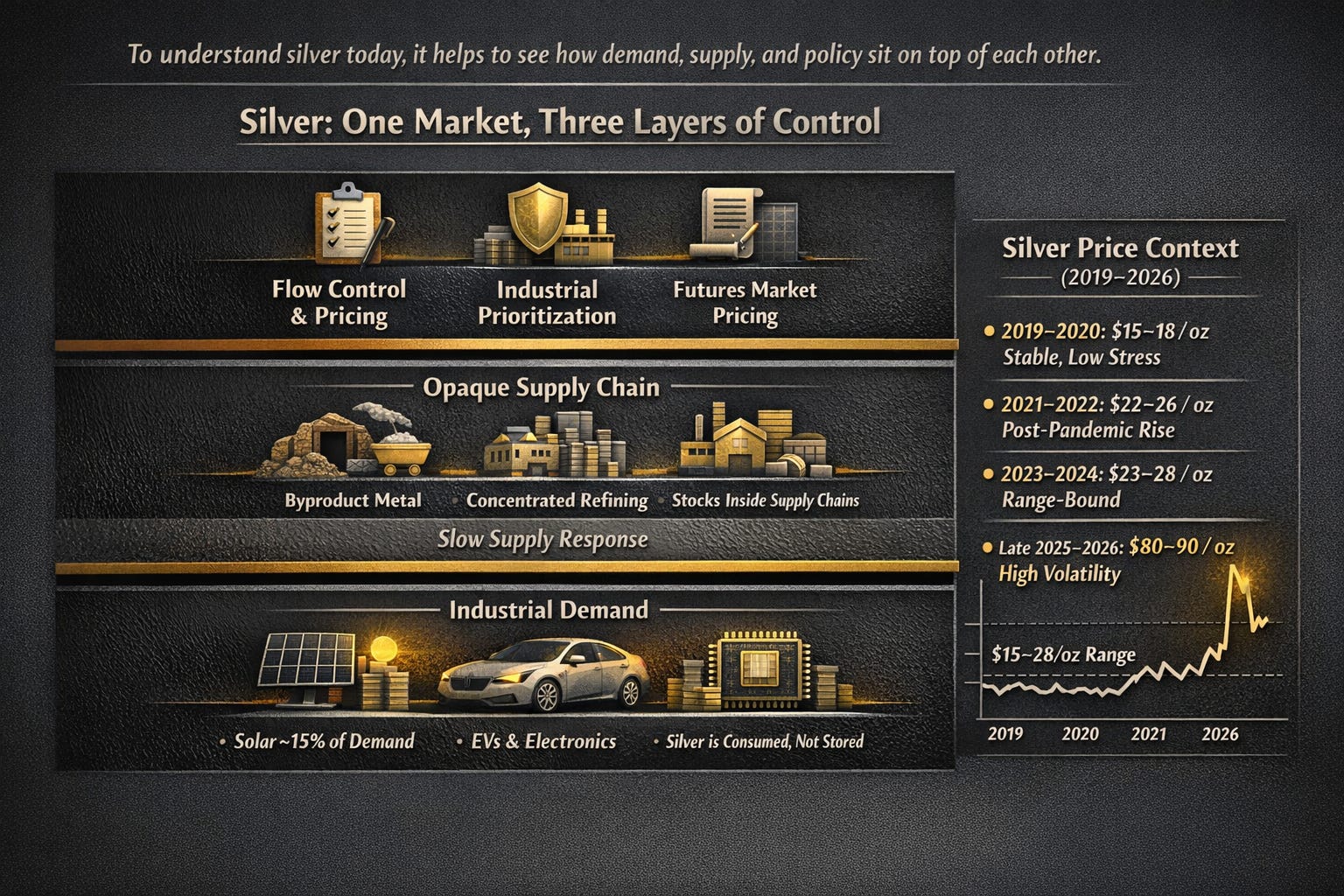
What changed is not just price, but the speed and instability of price movement.
4. Paper Markets Are Amplifying Volatility
Silver prices are discovered primarily through futures markets, especially COMEX in the United States.
As prices surged, CME (Chicago Mercantile Exchange) adjusted margin requirements to scale with contract value, increasing the capital required to hold positions at higher prices. In a relatively small market, this forces faster repositioning and magnifies price swings.
Silver’s volatility is typically two to three times higher than gold’s, and this structural sensitivity is now more visible.
This is not manipulation. It is how leverage behaves under stress.
The recent sharp correction up to approx 38% in silver prices only reinforces this dynamic. A pullback of this magnitude does not negate industrial demand or long-term constraints. It highlights how quickly silver reprices when leveraged positions unwind faster than physical demand can adjust. Volatility here is a feature of the system, not a verdict on the metal’s role.
Why Silver Is Harder to Stabilize Than Gold
Gold is held.
Silver is consumed.
Gold mainly responds to currency, fear, and reserves. Silver responds to those forces plus industrial deployment, supply rigidity, and policy decisions.
That combination makes silver more unstable and more informative.
Hook
Silver is not misbehaving. It is reflecting strain elsewhere.
What This Changes in Practice
For individuals
Silver is no longer a simple hedge. Exposure requires accepting volatility and understanding that industrial demand matters as much as macro sentiment.
For businesses
Silver is no longer a predictable input. Inventory planning and supply security matter more than short-term price forecasts.
For policymakers
Silver exposes the gap between transition ambition and material readiness. Prices react before systems adjust.
How I Think About Silver as an Asset
When I look at silver as an asset, I focus on how it is accessed, not just on price.
Physical silver makes sense for ownership. It removes counterparty risk, but comes with storage and liquidity friction. Premiums and discounts can diverge from spot prices during stress.
Silver ETFs offer simple price exposure without storage. They are liquid and efficient, but remain paper instruments that reflect market sentiment faster than physical availability.
Futures and leveraged products are trading tools, not long-term exposure. Silver’s volatility makes leverage unforgiving and unsuitable for most investors.
Mining equities provide indirect exposure, but behave like stocks first. Costs, execution, and geopolitics matter as much as silver prices.
For me, silver is not a core stabilizing asset. It is a contextual exposure tied to transition pressure and industrial demand.
The key decision is not how much silver to hold.
It is which form of silver aligns with your intent.
Closing
I do not see silver as a speculative anomaly.
I see it as an early indicator that the energy transition and digital build-out are pushing against material limits.
When a working metal becomes volatile, it usually means the system is asking more of it than supply can easily deliver.
Silver is already sending that message.
© Beyond Coordinates 2026
This is human-generated content, verified using GLTR and RADAR models.