


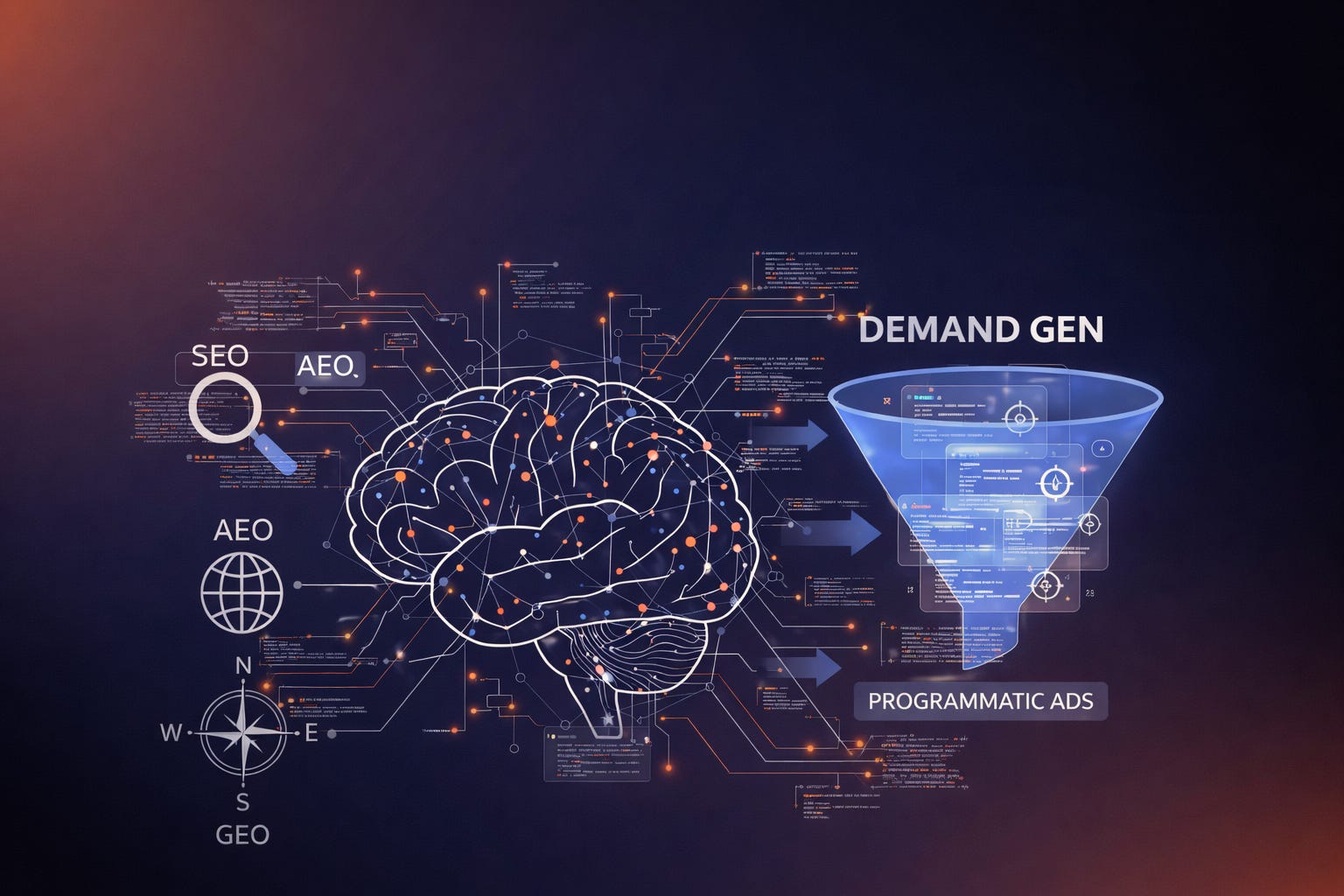
Epigraph
People no longer search to decide.
They are guided long before they search.
△ ▽ ⧋
Cognitive Index | By Beyond Coordinates
Reader Note
This essay is written for marketing leaders, demand generation heads, marketing operations teams, and MarTech decision makers.
It does not explain SEO, AEO, GEO, or programmatic advertising mechanics.
It examines how search, discovery, demand generation, and the pricing of attention are being reorganized by intelligent systems, and what that means for enterprise growth strategy.
If you work at the intersection of marketing, AI, and revenue systems, this series goes deeper.
Subscribe to follow the full Cognitive Index.
Prologue
I started my marketing/demand generation career in a world where keywords were everything.
If you understood intent, you won.
If you ranked, demand followed.
Keywords were not just a tactic.
They were the organizing unit of marketing strategy.
What unsettled me in recent years was not traffic loss.
It was signal collapse.
Between 2020 and 2024:
Search impressions continued to grow
Organic click-through rates declined by nearly 20 percent
Zero-click searches crossed 55 percent for informational queries
The system was still active.
But it was no longer transparent.
Search was still happening.
Discovery had started moving elsewhere.
From Keywords to Interpretation
Discovery did not disappear. It started moving through systems we do not directly see.
People still type queries. Machines no longer optimize primarily for words.
They optimize for:
Meaning over syntax
Context over frequency
Probability over precision
Reusability of ideas over originality
Large language models do not rank pages.
They synthesize patterns.
Research now shows:
Over 60 percent of AI generated answers draw repeatedly from a narrow pool of sources
Conceptual clarity outperforms publishing frequency
Keywords did not disappear.
They were absorbed.
Discovery shifted:
From keywords to questions
From questions to answers
From answers to synthesized narratives
We are no longer optimizing content to be found.
We are optimizing ideas to survive interpretation.
SEO, AEO, and GEO as a Single System
Most content treats SEO, AEO, and GEO as competing tactics.
I see them as a stacked system:
SEO (Search Engine Optimization) optimizes for being found
AEO (Answer Engine Optimization) optimizes for being answered
GEO (Generative Engine Optimization) optimizes for being remembered
SEO still anchors high intent demand.
Roughly 70 percent of late stage B2B discovery still resolves through classic search.
AEO dominates mid funnel understanding.
AI generated summaries now appear across a significant share of informational queries.
GEO shapes early preference.
Repeated inclusion in generated answers improves brand recall even without visits.
This is accumulation, not replacement.
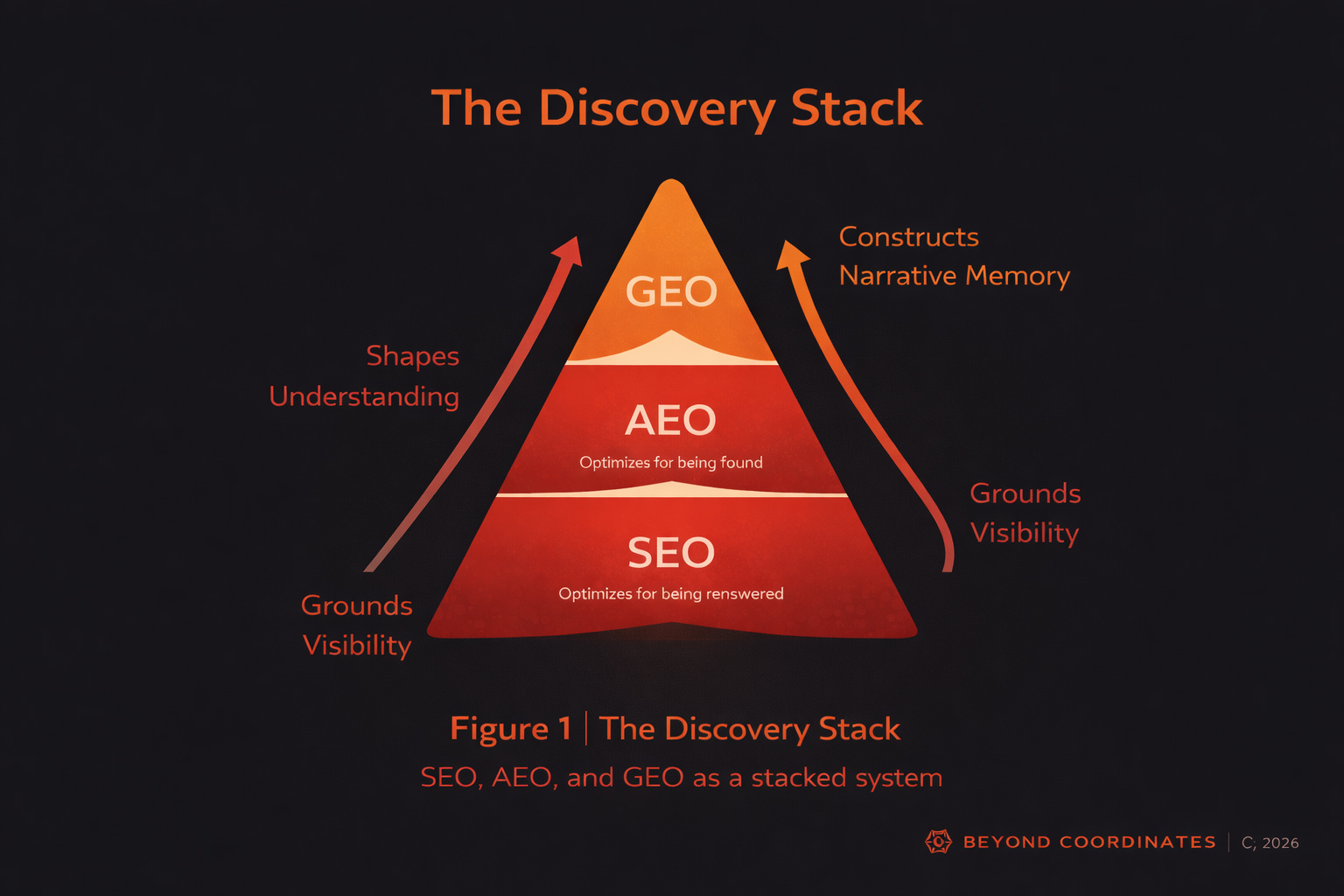
The Discovery Stack
A triangular model showing SEO anchoring visibility, AEO shaping understanding, and GEO constructing narrative memory.
Where Programmatic Advertising Quietly Fits
While organic discovery was becoming cognitive, paid media was undergoing a parallel shift.
Programmatic advertising stopped buying clicks.
It started buying probability.
Across Google Display, DSPs, and SSPs:
Inventory is priced by expected behavior, not placement
CPMs fluctuate based on inferred intent, not expressed intent
Bids are optimized by models, not marketers
Demand side platforms no longer ask who searched.
They ask who is likely to decide.
Supply side platforms no longer sell space.
They sell predicted attention windows.
This means:
CPMs rise even when click through rates fall
Retargeting costs increase as preference forms earlier
Visibility is auctioned before intent becomes visible
Programmatic ads are no longer demand capture tools.
They are demand conditioning systems.
The Triangle That Governs Modern Discovery
I now think of discovery as a triangle.
SEO grounds visibility
AEO structures understanding
GEO constructs narrative gravity
Programmatic advertising wraps around this triangle.
It reinforces:
What systems believe about a user
What narratives are repeatedly shown
What feels familiar before intent appears
Buyer research now begins 6 to 12 weeks before any form fill.
By the time demand becomes measurable, it is already priced into CPMs.
This is no longer a channel optimization problem.
It is a cognition and economics problem.
What the Signals Are Indicating
Across industries, the same patterns repeat:
Content output doubled while engagement flattened
CPMs increased despite stable conversion rates
Attribution confidence declined across multi touch models
Nothing is broken.
Value is simply being delivered earlier, invisibly, and auctioned in advance.
Discovery did not shrink.
It moved upstream and became priced.
What This Means for Demand Generation
I no longer think of demand generation as traffic creation.
Demand now forms before buyers know they are looking.
It forms when:
An assistant explains a category
A generative system defines norms
A DSP repeatedly reinforces a narrative
By the time intent becomes visible:
Most buyers already have a preferred vendor
Retargeting efficiency drops sharply
Late stage content has limited influence
Demand generation has shifted from capture to conditioning.
The role is no longer to intercept demand.
It is to shape the ideas that systems circulate first.
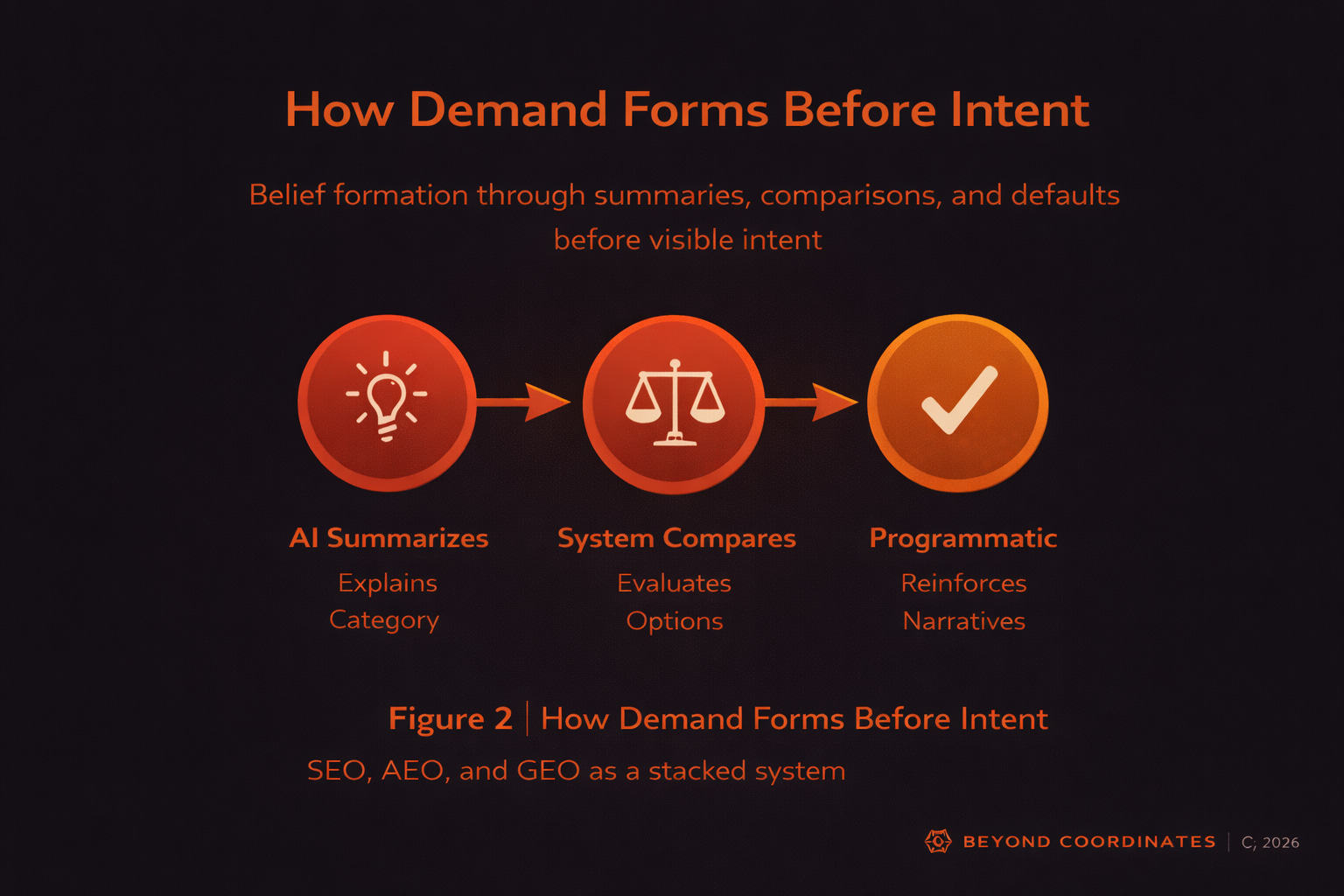
How Demand Forms Before Intent
A flow showing belief formation through AI summaries, programmatic reinforcement, and narrative defaults before visible intent.
Beyond Coordinates analyzes how AI reshapes discovery systems, pricing models, and enterprise revenue architecture.
What Breaks Inside Marketing Functions
For demand leaders:
Campaigns amplify belief rather than initiate it
Media buying becomes belief reinforcement
For marketing operations:
Measurement shifts from volume to influence
Content and media governance merge
Attribution becomes probabilistic
Ops stops being plumbing.
It becomes the nervous system.
For CMOs and functional leaders:
Marketing becomes a trust surface for algorithms
Brand becomes an input variable for machines
A Short Glossary
Demand side platform (DSP)
Systems that bid on probability of outcomes.
Supply side platform (SSP)
Systems that price predicted attention.
CPM (Cost Per Mille)
The market price of belief, not impressions.
Ambient intent
Needs inferred before expression.
Epilogue
Search taught people how to ask.
Programmatic systems learned how to predict.
Generative systems are learning how to decide.
The winners will not be those who buy more traffic.
They will be those whose thinking systems prefer.
Discovery has not disappeared.
It has become cognitive and economic.
Strategic Implication
Search fragmentation is not a channel shift. It is an architecture shift.
Marketing leaders who treat it as a tactic will chase platforms.
Those who treat it as infrastructure will redesign growth systems.
Reader Action
If this changed how you think about SEO, AEO, GEO, and demand architecture, explore the full Cognitive Index series at Beyond Coordinates.
Each essay builds on the structural shift from channel marketing to intelligence-driven discovery systems.
Sources
Zero click search behavior studies
Programmatic advertising and CPM trend reports
AI assisted discovery and buyer journey research
Human written. Verified via Radar and GLTR.
If you are thinking through similar shifts in your organization, I would be interested in your perspective. hello@beyondcoordinates.com
© Beyond Coordinates 2026. All rights reserved.