

Salesforce + Informatica: When Data Becomes the Real Product
Inside Salesforce’s decade-long strategy to fix the part of enterprise systems no one wanted to own — and why it matters for AI, ISVs, and consulting partners | Cognitive Index 06

▲ ▼ ■ Cognitive Index | By Beyond Coordinates
I’ve followed Salesforce’s acquisitions for more than a decade, and this Informatica move felt different the moment I saw it. Not loud, not rushed — just a quiet attempt to fix the one layer of enterprise systems that causes 80% of delays, rework, and AI failures.
1. The part of the enterprise everyone avoids
Whenever I walk into a large organisation, I don’t have to look hard to find the real problems.
They don’t start in CRM.
They don’t start in ERP.
They start in the quiet, messy space between systems.
Every company I’ve seen struggles with things like:
CRM says 4,800 active customers
ERP says 5,200
Marketing claims 6,100
Service logs show something else entirely
This is normal.
Not good — just common.
In the healthcare and banking projects I’ve observed, the average enterprise runs 60–120 systems, each maintaining its own slightly distorted version of the truth.
So when Salesforce spent nearly USD 8B on Informatica, I didn’t see a “big acquisition story.”
I saw a company finally stepping into the layer everyone avoids because it’s boring, complicated, and absolutely critical.
2. MDM, without the jargon
MDM (Master Data Management) sounds like corporate vocabulary, but it’s really simple:
If five systems describe the same customer differently, nothing you build on top will ever work right.
Healthcare systems carry 8–20% duplicate patient records.
Banks maintain 20–40 versions of customer data across departments.
Insurers lose 30–40% of onboarding time to KYC/AML rework due to mismatched records.
Informatica’s job is to clean all of that.
They:
dedupe
validate
track lineage
unify identities
enforce trust
Now Salesforce is wiring this directly into Data Cloud — which already doubled usage year-on-year — turning it into the actual backbone, not the optional add-on.
I’ve always believed AI is only as good as the data under it.
Now Salesforce believes it too.
3. Salesforce has been laying this track for years
When I zoom out, the sequence feels intentional:
Heroku — build apps
ExactTarget — marketing engine
Demandware — commerce
MuleSoft — connect systems (now handling 1+ trillion API calls per month)
Tableau — understand the data
Slack — coordinate people
Own Company — protect data
Informatica — trust the data
The pattern is clean:
Connect → Clean → Understand → Collaborate → Act.
Informatica closes the structural gap Salesforce could never fill on its own.
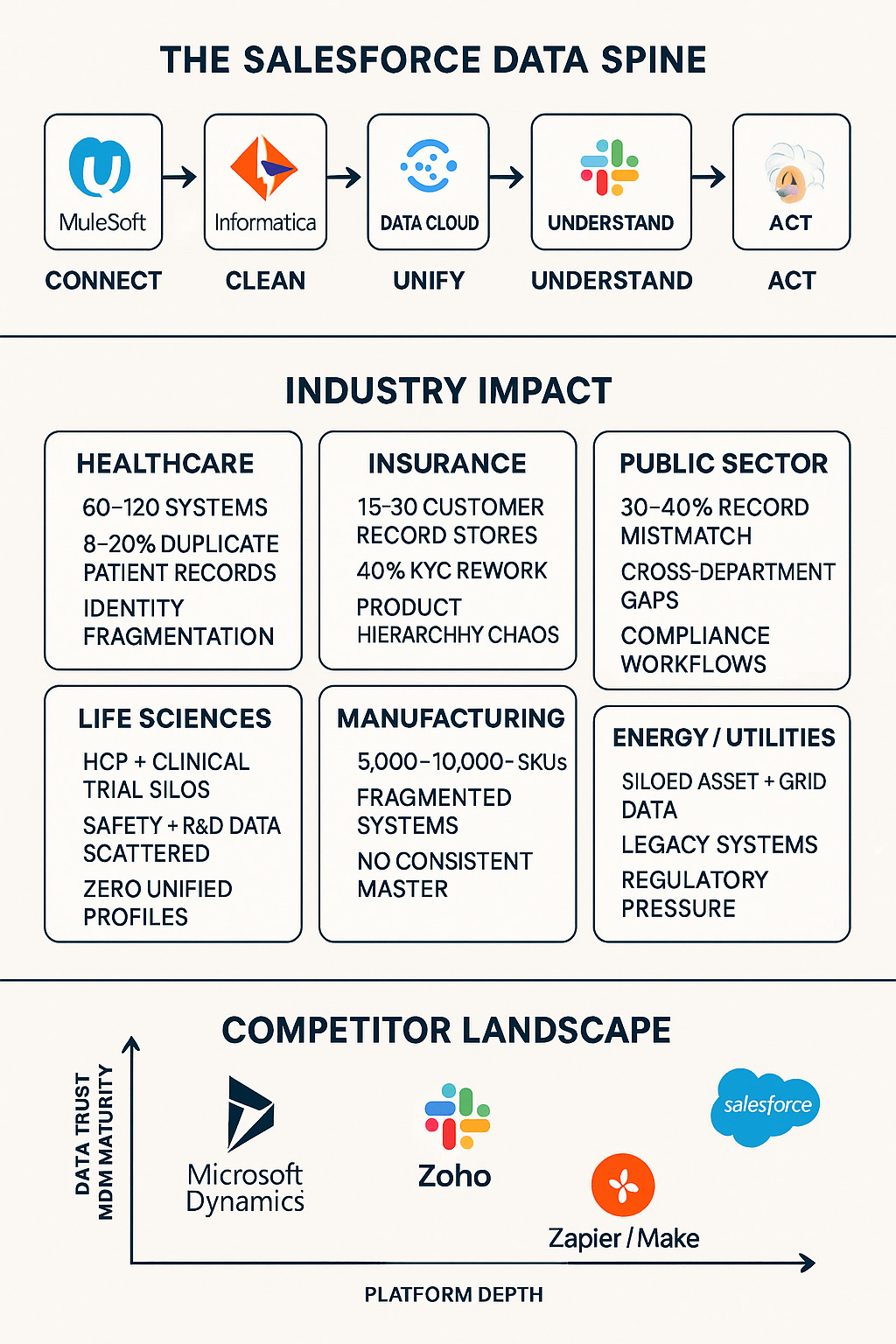
Salesforce’s evolving data backbone: the integration layer, the trust layer, and the ripple effects across industries and rival platforms.
4. Salesforce’s Amazon move (but in enterprise systems)
Amazon didn’t win because it sold everything.
It won because it fixed the painful parts nobody tackled:
infrastructure
fulfilment
payments
reliability
Salesforce is playing a similar game inside enterprises:
mismatched data
brittle integrations
dashboards that contradict
APIs that break when a single field changes
AI models failing because of inconsistent inputs
With Informatica, Salesforce isn’t expanding — it’s stabilising.
This is infrastructure, not innovation theatre.
5. Low-code APIs and unlimited integration — finally real
For years, low-code and integration have sounded like promises.
But without clean data, they collapse under their own optimism.
Low-code APIs
Teams can create stable APIs without backend rewrites.
This matters because 70% of enterprise delays come from “API schema inconsistencies and broken sync logic,” not from strategy.
Unlimited integration
Integration stops being:
“we have 1,000 connectors”
…and becomes:
“things don’t break every time an upstream field changes.”
Manufacturers running 10,000+ SKUs, or retailers syncing millions of records, finally get predictability instead of patchwork.
It’s quiet, but it’s transformational.
6. The ripple for ISVs, SIs, and customers
ISVs (Independent Software Vendors)
AppExchange partners will now be judged on:
how they treat Salesforce’s master record
if they align with Data Cloud’s identity graph
whether their data models play well with Agentforce
if they reduce, not increase, duplicate records
This subtly raises the ecosystem’s quality bar.
SIs (System Integrators) & Consulting Firms
The shift is bigger than it looks.
Less of:
fixing sync failures
cleaning CSV dumps
maintaining duct-tape connectors
More of:
designing industry data models
cross-cloud architectures
governance frameworks
accelerators built on clean data
AI readiness consulting
The work moves from integration plumbing to systems thinking.
Customers
They finally get:
fewer rework cycles
consistent dashboards
predictable automation
cleaner analytics
AI that can actually trust its inputs
This is the first acquisition in years that directly improves daily enterprise life.
7. The Ecosystem Layer — Clouds, Industries, and Competitors I See Feeling the Heat
When I look across Salesforce’s clouds, the impact is immediate.
Marketing Cloud gets relief.
The average Marketing Cloud customer merges 5–12 data sources, which is why journeys often misfire.
Informatica cleans the inputs.
Journeys stop guessing.
Pardot (Account Engagement) finally escapes its long-standing duplicate lead pains — again, not because Pardot was flawed, but because the data feeding it was.
Marketo isn’t untouched.
Marketo is strong in enterprise B2B, but nearly 90% of customers bolt on Segment, Tealium, or custom identity tools.
Salesforce now has that layer natively — a real competitive advantage.
Data Cloud becomes the centre of gravity.
It becomes the identity graph + warehouse + activation layer instead of “just another cloud.”
Some industries get a rare reset.
From what I’ve seen, the biggest winners are:
Healthcare (60–120 systems; 8–20% duplicate patients)
Life Sciences (HCP + trial data fragmentation)
Insurance & BFSI (15–30 customer record stores per firm)
Manufacturing (thousands of SKUs, fragmented plants)
Public Sector (30–40% record mismatch between departments)
These industries finally get a data spine they can trust.
And the competitors? I don’t think they can ignore this.
HubSpot: Excellent UX; no deep MDM layer. Ceiling stays mid-market.
Zoho: Huge suite; consistency across 55+ apps is tough.
Dynamics: Strongest rival, but still missing native MDM.
Zapier / Make: They move data but don’t reconcile it — and the future requires reconciliation.
Every platform entering the AI decade has to solve the data-trust problem.
Salesforce just did it first.
8. The culture engine — Dreamforce, TrailblazerDX, DemoJam, Agentforce
I’ve always felt Salesforce doesn’t just build products — it builds alignment.
Dreamforce sets the story.
TrailblazerDX trains the builders.
DemoJams showcase compliant ISVs.
Partner Summits push SIs to change their offerings.
Agentforce demos show what “AI that actually works” requires.
When Salesforce repeats clean data + governance across all these stages, the ecosystem listens and then it evolves.
Informatica fits neatly into this rhythm.
9. Closing note
I don’t see the Informatica deal as Salesforce expanding its portfolio.
I see it as Salesforce taking ownership of the one layer nobody wanted to claim — the messy middle where systems disagree, integrations break, and AI fails quietly.
Amazon won by fixing the invisible pain.
Salesforce is aiming for the same outcome, just in a different world.
If this works, then by 2030 “using Salesforce” won’t mean CRM at all.
It’ll mean your organisation finally runs on one coherent truth instead of a dozen contradictory ones.
A small shift, but a foundational one.
Sources:
IDC Global Salesforce Economy Impact
Global Healthcare Duplicate Record Studies (HIMSS / AHIMA ranges)
CRM Market Share & Dynamics Ecosystem Reports
MuleSoft Public Transaction Volume Stats
Industry Analyses on Data Cloud, MDM, and AI Readiness
Human-generated content. Radar/GLTR pattern check: Passed.
Copyright © Beyond Coordinates, 2026