

Revenue Intelligence and RevOps Systems
AI RevOps, Forecasting, and the Rise of Predictive Pipelines


△ ▽ ⧋
Cognitive Index | By Beyond Coordinates
Functional Cognition 03
If you missed the previous piece in the Functional Cognition series, you can read FC 02 | Agentic CRM and Customer Systems where I explored how CRM platforms are evolving from customer databases into AI assisted engagement systems.
This piece explores how Revenue Intelligence and RevOps systems are evolving from static reporting environments into predictive commercial ecosystems driven by AI, forecasting, behavioral signals, and operational coordination.
As enterprise GTM systems become increasingly data intensive, the article examines both the opportunities and the growing operational tensions emerging across modern revenue operations.
Readers Note
This piece may be relevant for:
RevOps Leaders
GTM Strategists
Revenue Operations Managers
Sales and Customer Success Leaders
B2B SaaS Founders
Enterprise Transformation and AI Strategy Teams
Over the last year, I have noticed something interesting across sales and GTM conversations. Companies are no longer talking only about CRM adoption or dashboard visibility. More teams are trying to understand why revenue movement feels harder to predict even after adding more tooling, more analytics, and more automation.
In many cases, the problem is not lack of data. It is too much fragmented data with very little operational clarity around it.
The modern pipeline is no longer just being tracked. It is slowly being interpreted.
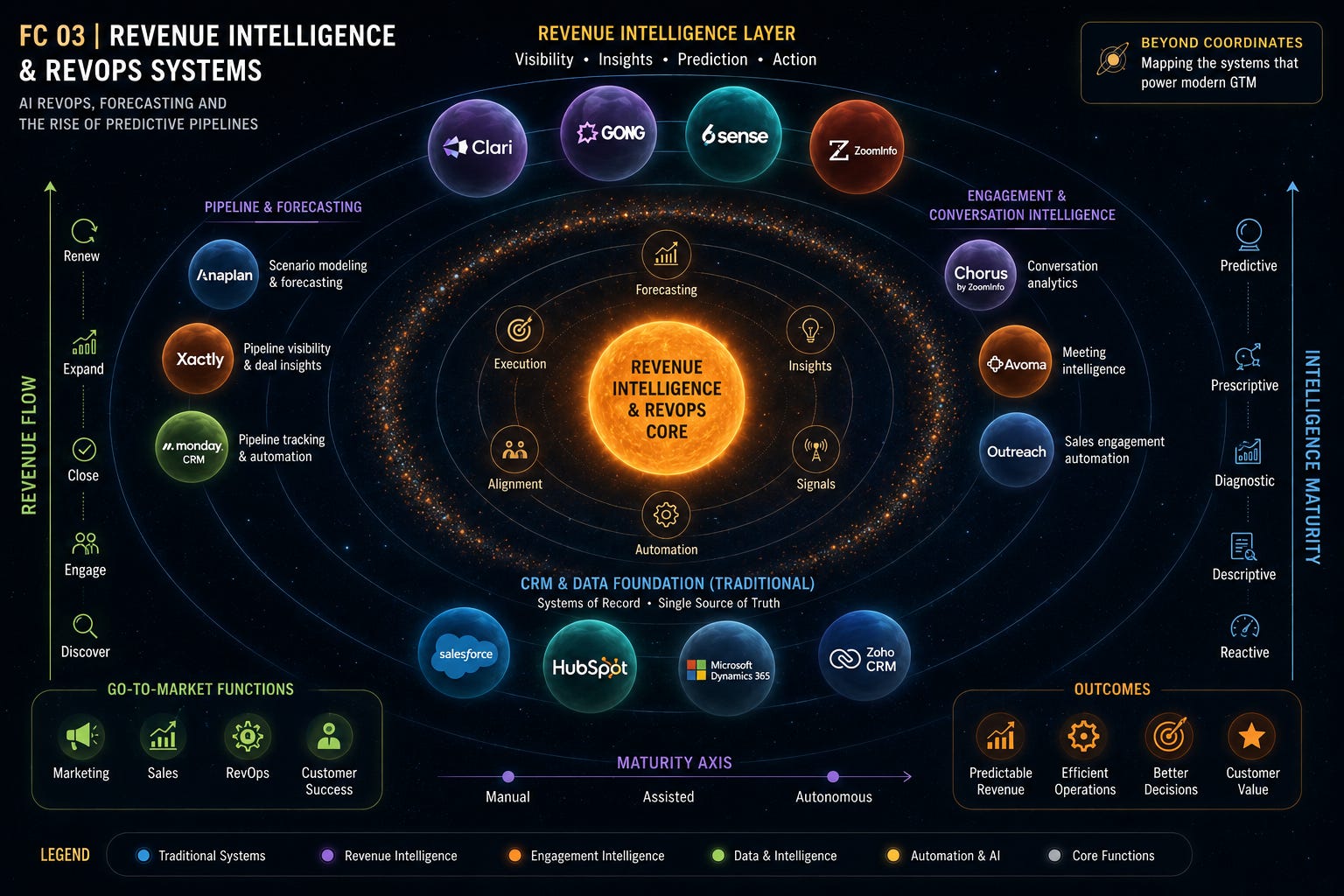
Beyond Coordinates Systems Map | Revenue Intelligence and RevOps Ecosystems
The Revenue Intelligence Stack is evolving from static CRM visibility toward predictive commercial systems where forecasting, engagement, signals, and operational coordination increasingly operate as connected intelligence layers across the modern GTM ecosystem.
From CRM to Revenue Intelligence
For years, CRM systems mainly acted as structured customer records.
Then RevOps started aligning workflows between:
sales
marketing
customer success
account management
Now another layer is emerging.
Revenue Intelligence systems are beginning to:
score buyer behavior
monitor engagement signals
identify deal risks
predict pipeline movement
improve forecasting visibility
prioritize accounts dynamically
What stands out to me is that many companies are no longer satisfied with post quarter reporting. They want visibility while commercial behavior is still forming.
That explains why ecosystems like:
Clari
Gong
6sense
HubSpot
Apollo.io
have gained so much momentum recently.
What I Think Is Actually Changing
Most organizations already have:
dashboards
CRM systems
reporting layers
analytics tools
But many still struggle with basic operational questions:
Why did pipeline velocity suddenly slow down?
Which buyer signals genuinely matter?
Which deals are active versus artificially inflated?
Which accounts are visible in marketing but invisible to sales teams?
To me, this is where the RevOps conversation starts becoming more important than the tooling conversation itself.
The market is now pushing aggressively toward:
AI assisted forecasting
intent intelligence
pipeline scoring
automated outbound coordination
behavioral analytics
signal based selling
But underneath all this, companies are really trying to reduce uncertainty.
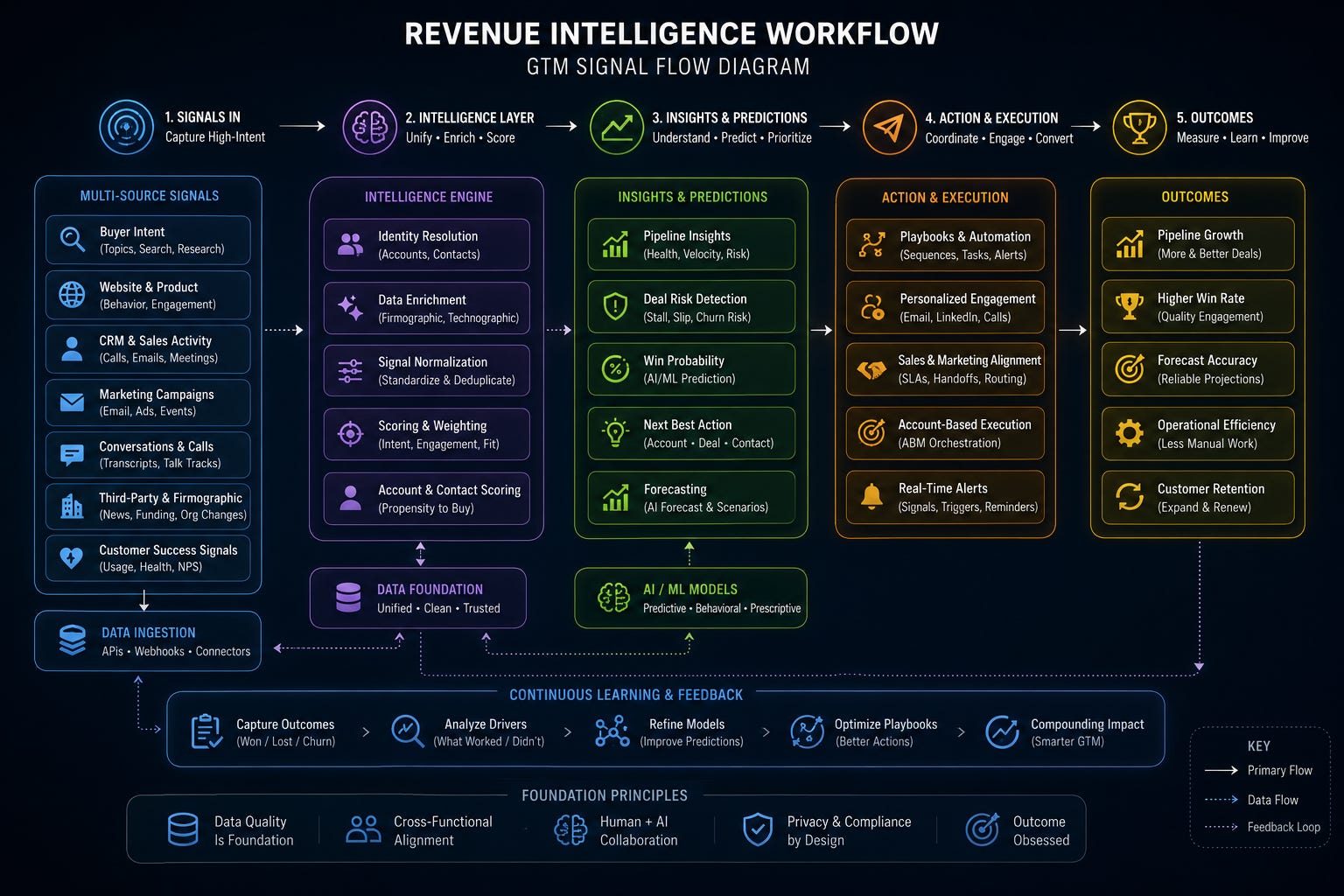
Revenue Intelligence Workflow Infographic or GTM Signal Flow Diagram
The Emerging Tension
This shift is not as smooth as many software narratives make it sound.
I keep seeing organizations deploy multiple AI sales and RevOps tools without fixing:
fragmented workflows
inconsistent CRM usage
disconnected GTM operations
poor data hygiene
As a result:
automation increases faster than clarity
teams become overloaded with signals
attribution confusion continues
forecasting still becomes political near quarter endings
In some environments, I honestly think AI is accelerating noise faster than understanding.
That tension matters because more automation does not automatically create better revenue intelligence.
Sometimes it simply creates faster operational confusion.
Operational Impact Snapshot
Startup and SMB Ecosystems
Faster GTM experimentation
Leaner sales operations
AI assisted outbound workflows
Lower dependency on large RevOps teams
Mid Market and Enterprise Teams
Better sales and marketing alignment
Improved forecasting visibility
Reduced reporting fragmentation
Stronger pipeline coordination across departments
Revenue and GTM Operations
Faster identification of deal stagnation risks
Intent based lead prioritization
AI assisted pipeline monitoring
Continuous revenue visibility
Industry Adoption Trends
SaaS and AI Native Businesses
Using AI RevOps systems to automate forecasting, outbound coordination, and pipeline intelligence.
B2B Services and Consulting
Improving account visibility, lifecycle coordination, and operational alignment across distributed teams.
Financial Services
Expanding relationship intelligence and workflow visibility across large client ecosystems.
Industrial and Manufacturing Operations
Connecting commercial visibility with distributor coordination, service workflows, and field operations.
Closing Reflection
I do not think most companies are anywhere close to fully autonomous revenue systems.
Many are still dealing with disconnected tools, overloaded dashboards, inconsistent forecasting, and fragmented operational visibility. But the broader direction is becoming difficult to ignore.
Revenue systems are slowly evolving from systems of record into systems of interpretation.
To me, the modern pipeline no longer looks like a static reporting structure. It increasingly looks like a behavioral prediction system that is trying to anticipate movement before humans fully recognize it.
© 2026 Beyond Coordinates. All rights reserved.
This analysis, visual framework, and accompanying systems maps are part of the Beyond Coordinates Functional Cognition series exploring the evolution of intelligent enterprise systems, operational architectures, and emerging commercial ecosystems.