


△ ▼ △
The Expanding Orbit | By Beyond Coordinates
This essay is part of The Expanding Orbit series at Beyond Coordinates.
Here, I examine how retail is moving away from excess and toward alignment. Not through slogans or technology hype, but through quieter shifts in visibility, inventory discipline, supply chain resilience, and recommerce.
The piece connects consumer behavior with system design, showing how decisions are shaped upstream and why misalignment has become a measurable cost. It is written for readers who want to understand how retail actually works now, not how it is marketed.
Epigraph
“Systems decide visibility long before consumers decide value.”
When I look at retail today, I don’t see slowdown.
I see restraint, structure, and a quiet re-ordering of how consumption works.
Prologue
For a long time, retail followed a simple logic:
more stores, more products, more choice.
I’ve watched that logic work — and then slowly exhaust itself.
Today, I notice shoppers hesitating longer. I see return rates rising. I see thrift stores spreading across cities that once celebrated only “new.” I also see retailers carrying less inventory, yet understanding their customers better than before.
What stands out to me most is this:
software increasingly decides what we see before we decide what we want.
Retail hasn’t slowed down.
It has become more deliberate.
This piece is my attempt to map that shift — away from excess and toward discipline, clarity, and system-level thinking.
Retail Is No Longer Growing the Old Way
Global retail sales are still rising, but I don’t see growth translating into comfort.
Margins are under pressure. Costs tied to logistics, energy, inventory holding, digital operations, and returns are rising faster than revenue in many markets.
What I see retailers focusing on instead is efficiency:
improving inventory turnover
reducing waste and markdowns
shortening planning cycles
increasing predictability
The central question has quietly changed.
It’s no longer “How do we sell more?”
It’s “How do we sell better?”
How Algorithms Quietly Shape What People Buy
Most people don’t feel it, but I think shopping decisions today are influenced long before intent forms.
I see it in everyday behavior:
product recommendations shaping discovery
search results ranked differently for different users
prices adjusting in real time
homepages changing subtly with each visit
Behind this sit tools many retailers now consider standard:
Search and recommendation systems like Algolia and Bloomreach
Personalization platforms such as Dynamic Yield and Adobe Target
Pricing and promotion systems like Revionics and Pricemoov
Customer data platforms like Segment and Tealium
These systems don’t push people to buy.
What I notice is that they reduce noise.
Data supports this:
roughly 60–70% of online purchases are influenced by recommendations
shoppers now see fewer products per session than a decade ago
retailers using personalization report 5–15% higher conversion rates
Retail is no longer about showing everything.
From what I observe, it’s about showing the right few things.
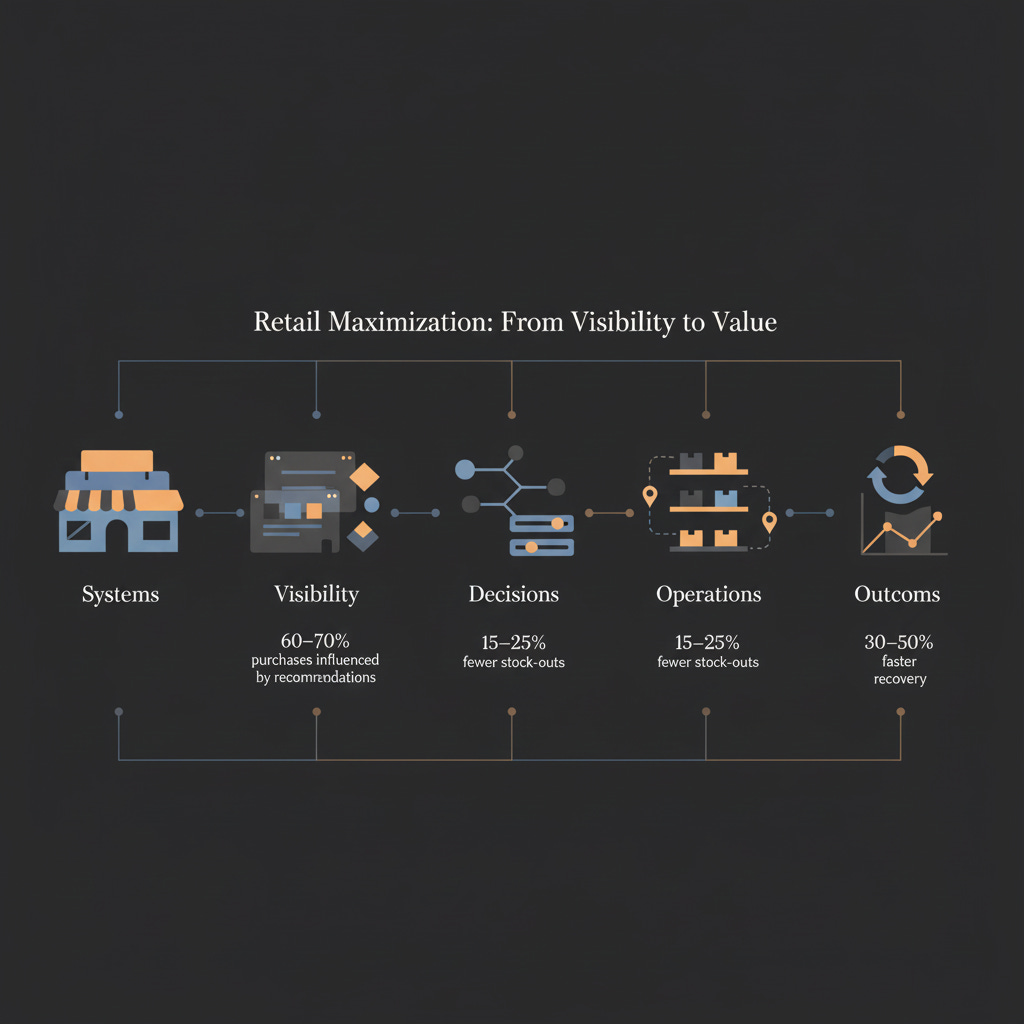
Retail maximization emerges when systems align before scale.
Retail Is Being Designed Around Decisions
When I compare retail now to even ten years ago, the shift is clear.
Earlier focus:
shelf placement
promotions
visual merchandising
Today, I see retailers obsessing over:
how quickly customers decide
where confusion appears
how demand aligns with supply
This explains trends I keep noticing:
smaller assortments
continuous planning instead of seasonal planning
forecasting that updates constantly
Retail performance today depends less on abundance and more on clarity.
Thrift, Reuse, and Sustainability Are Now Core Channels
I don’t see thrift as a fringe movement anymore.
Across categories, it’s becoming normal.
Clothing and fabric:
Resale platforms and buy-back programs are expanding. I see durability and quality being discussed more openly than novelty. Second-hand apparel is no longer hidden — it’s mainstream.
Electronics:
Refurbished phones and laptops are widely accepted. Warranty-backed resale has changed trust dynamics. What’s interesting is how resale pricing now influences new-product pricing.
Furniture and home:
Urban second-hand furniture markets are growing quickly. Rental and resale reduce logistics costs and waste. Longevity is becoming a selling point.
The numbers reinforce this shift:
recommerce is growing at 10–15% CAGR, faster than traditional retail
apparel resale alone is projected to cross $350–400B globally within the decade
thrift and resale stores continue expanding across regions
To me, this isn’t driven by marketing.
It’s driven by economics and awareness.
Supply Chains Are Now Judged by Resilience
The last few years made one thing obvious to me: cost-efficient supply chains are not always resilient ones.
Retailers that recovered faster did a few things differently:
they sourced from multiple regions
they built regional warehouses
they worked with flexible logistics partners
they sensed demand earlier
I’ve seen patterns repeat:
apparel sourcing split across South Asia, Southeast Asia, and Turkey
electronics production diversified beyond single-country dependence
furniture brands building regional manufacturing clusters
Data backs this up:
diversified supply chains recovered 30–50% faster from disruptions
lead times reduced by 15–25%
slightly higher buffers resulted in far lower losses
Supply chains are no longer optimized just for cost.
From what I see, they’re optimized for continuity.
Experience Has Become a Cost-Control Mechanism
I don’t view customer experience as branding alone anymore.
Poor experience creates very real costs:
higher returns
more customer support
weaker repeat behavior
Clear information, better sizing guidance, and simpler checkout flows reduce friction — and expenses.
Evidence shows:
returns are among retail’s largest hidden costs
small experience improvements can reduce returns significantly
repeat customers cost far less to serve than new ones
Good experience doesn’t just grow revenue.
It protects margins.
Too Many Tools, Not Enough Connection
When I look at most retail stacks today, I see abundance — and fragmentation.
Common issues I keep encountering:
data not flowing between systems
teams working in silos
promotions launched without inventory clarity
Typical outcomes:
demand created without supply readiness
customer service missing order context
planning lagging real behavior
Industry data reflects this:
integration costs now take up 20–30% of transformation budgets
simpler, better-connected systems consistently outperform complex ones
What I’ve learned is simple:
structure matters more than speed.
Where Retail Complexity Shows Its Cost
There’s a point where retail complexity stops being theoretical and starts showing up on the balance sheet. I see it most clearly when systems don’t align.
Globally, retailers now operate with 30–50 different software tools across commerce, marketing, inventory, logistics, and customer service. What surprised me when I first saw the numbers was not how advanced these stacks were — but how expensive their disconnect had become.
Studies consistently show that 20–30% of digital transformation budgets are spent not on new capability, but on integration, rework, and fixing gaps between systems. In practice, this shows up as promotions that outpace inventory, fulfillment delays despite strong demand, and teams relying on spreadsheets to reconcile what platforms cannot.
I’ve noticed a clear pattern among retailers that manage this better. They don’t add more tools. They simplify how tools work together.
When commerce platforms, inventory systems, marketplaces, and fulfillment logic are aligned, measurable changes follow:
10–20% improvement in inventory turnover
15–25% reduction in stock-outs
Lower return-related costs, especially in apparel and electronics
Faster rollout of new channels, including resale and marketplaces
This is where execution quietly matters.
Not as strategy.
Not as transformation theatre.
But as ongoing work that keeps experience, supply, and operations grounded in the same reality.
From where I stand, this layer has become unavoidable. As retail becomes more modular and more distributed, the cost of misalignment compounds quickly. The retailers that hold this together don’t necessarily look more innovative — they simply look more stable.
And stability, right now, is a competitive advantage.
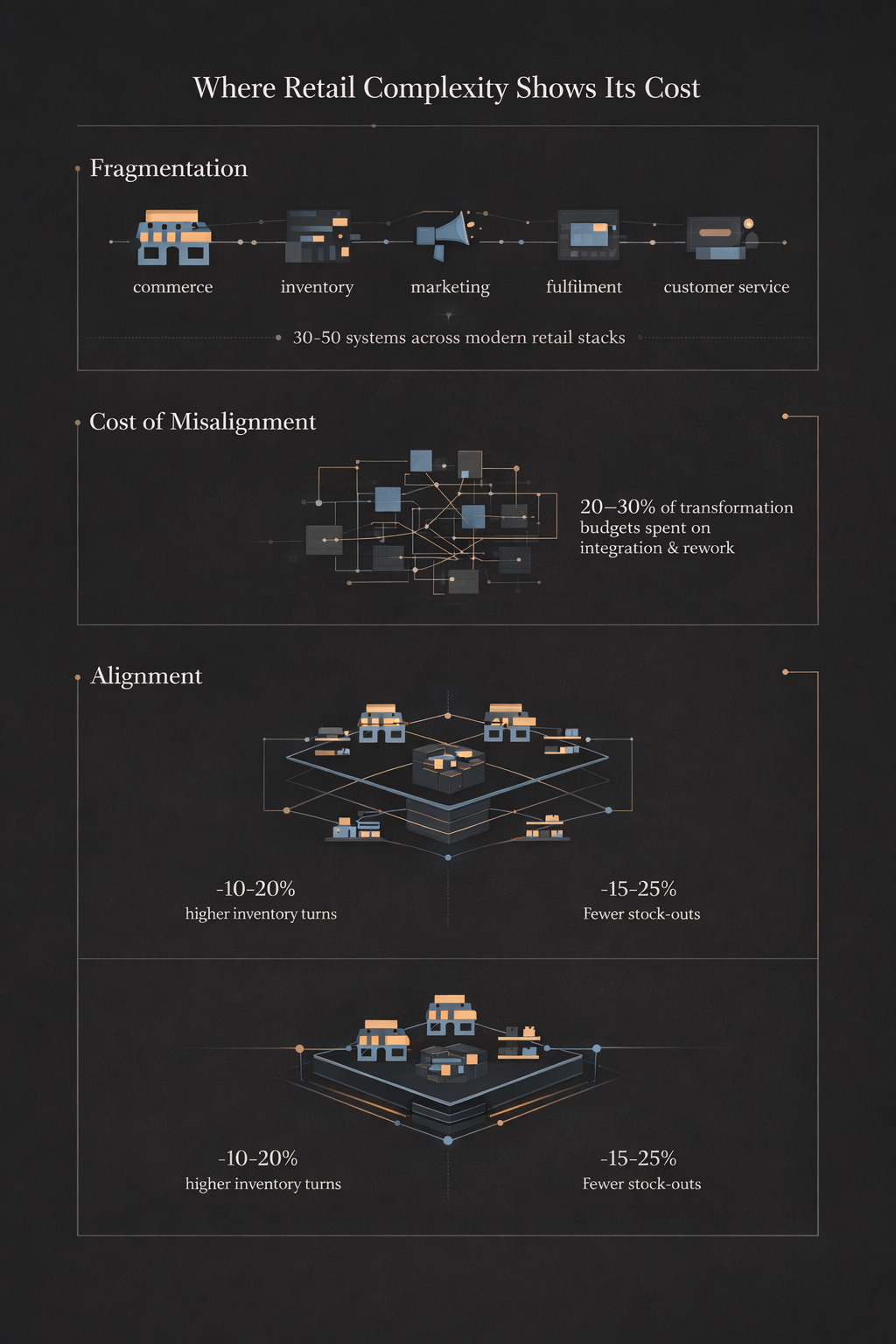
Retail complexity becomes costly when systems grow faster than their alignment.
The Role of Modern Retail Solution Providers
I also see a new layer emerging in the retail ecosystem.
These are solution providers sitting between:
pure software vendors
large traditional consulting firms
They tend to:
focus deeply on retail-specific problems
combine boutique agility with enterprise delivery
work closely with business and technology teams
They help retailers with:
commerce architecture design
system integration and simplification
inventory and fulfillment alignment
resale and sustainability enablement
They don’t sell tools.
From my perspective, they help retailers make systems usable.
What Research Continues to Show
Across academic and industry research, a few patterns remain consistent:
too much choice leads to decision fatigue
simpler systems improve satisfaction and conversion
reuse and resale reduce waste without hurting demand
technology shapes behavior indirectly
Retail, increasingly, is guided by evidence rather than instinct.
Epilogue
Retail isn’t shrinking.
From where I stand, it’s maturing.
Algorithms, thrift, resilient supply chains, and simpler systems all point in the same direction — discipline over excess.
The future of retail will belong to those who:
respect consumer attention
manage inventory carefully
reduce waste
build systems that adapt without overreacting
Retail maximization is not about selling more things.
It’s about selling with intention.
Sources
McKinsey & Company — Retail personalization and supply-chain resilience reports
Boston Consulting Group (BCG) — Global retail and recommerce analysis
ThredUp — Annual Global Resale Market Report
World Economic Forum (WEF) — Global supply-chain resilience studies
© Beyond Coordinates, 2026
Human-authored content verified via RADAR / GLTR analysis.