


△ ▼ △ The Expanding Orbit | By Beyond Coordinates
This essay is for operators, technology leaders, and enterprise teams working with AI beyond dashboards, pilots, and slideware.
Epigraph
For a long time, intelligence stayed digital.
Now it is entering physical space.
And once systems can act, not just advise, responsibility can no longer be abstract.
Prologue
I have spent few years thinking and writing about AI as software. Models, data, dashboards, predictions. Over the last year, something shifted in the conversations I am having with operators, engineers, and enterprise leaders.
AI is no longer only advising humans.
It is beginning to act.
Drones launch without pilots.
Robots patrol facilities overnight.
Systems inspect assets humans cannot safely reach.
Once intelligence acquires a body, decisions stop being theoretical. They create physical outcomes. That is when risk, accountability, and leadership design start to matter a lot more.
Defining Physical AI Without Hype
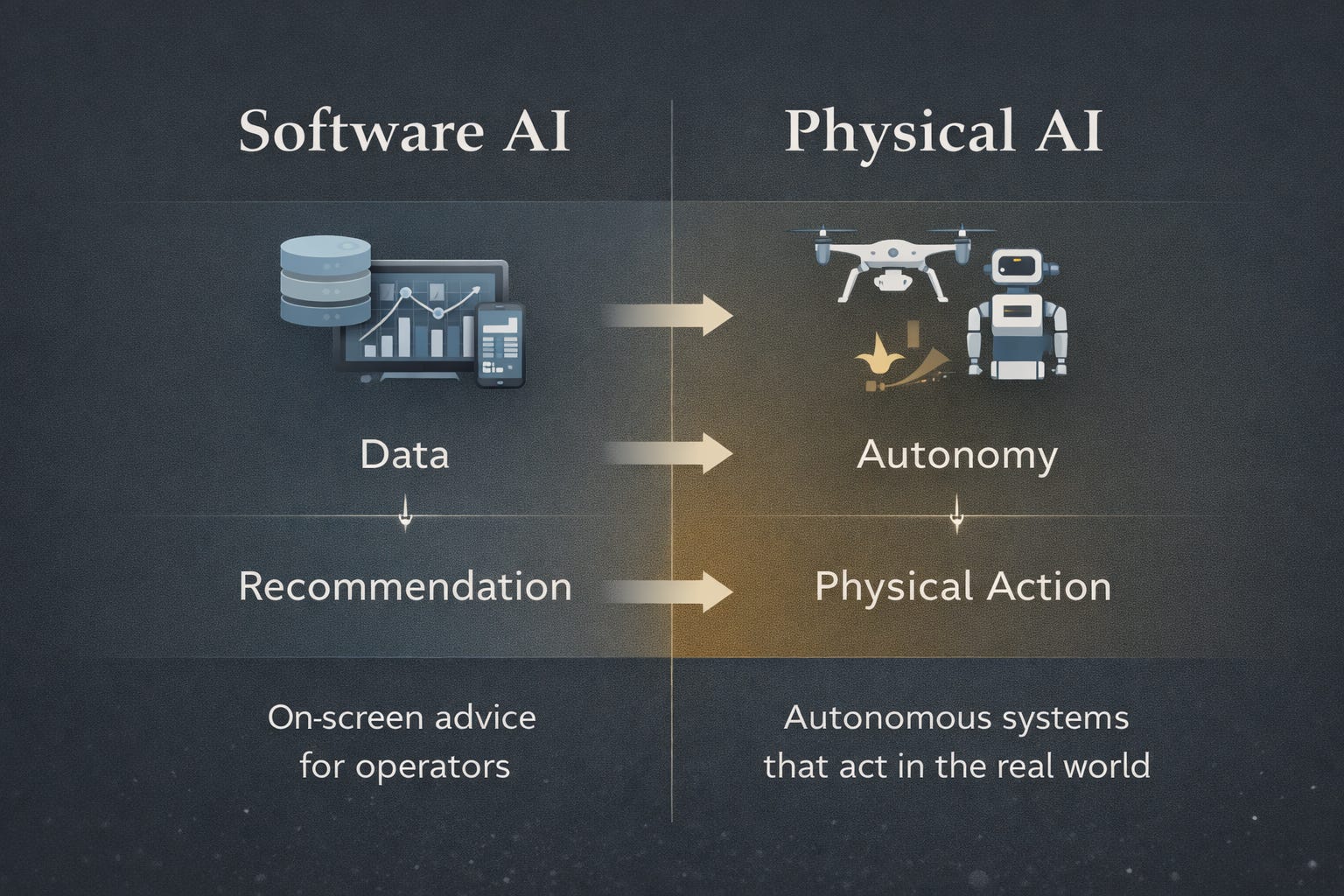
When I say Physical AI, I am not talking about robotics demos or futuristic marketing.
Physical AI combines three things:
Autonomy, where systems decide locally
Embodiment, where intelligence exists in a physical machine
Edge intelligence, where decisions are made close to the work
This is different from traditional automation that follows fixed rules. It is also different from software AI that mainly recommends actions. Physical AI takes action in the real world.
That is why adoption is slower but more serious. When something moves or flies, enterprises demand reliability, traceability, and control.
Strategic pause:
If an AI system takes physical action inside your operations, who owns the outcome when it fails?
The Infrastructure Shift: From Devices to Systems
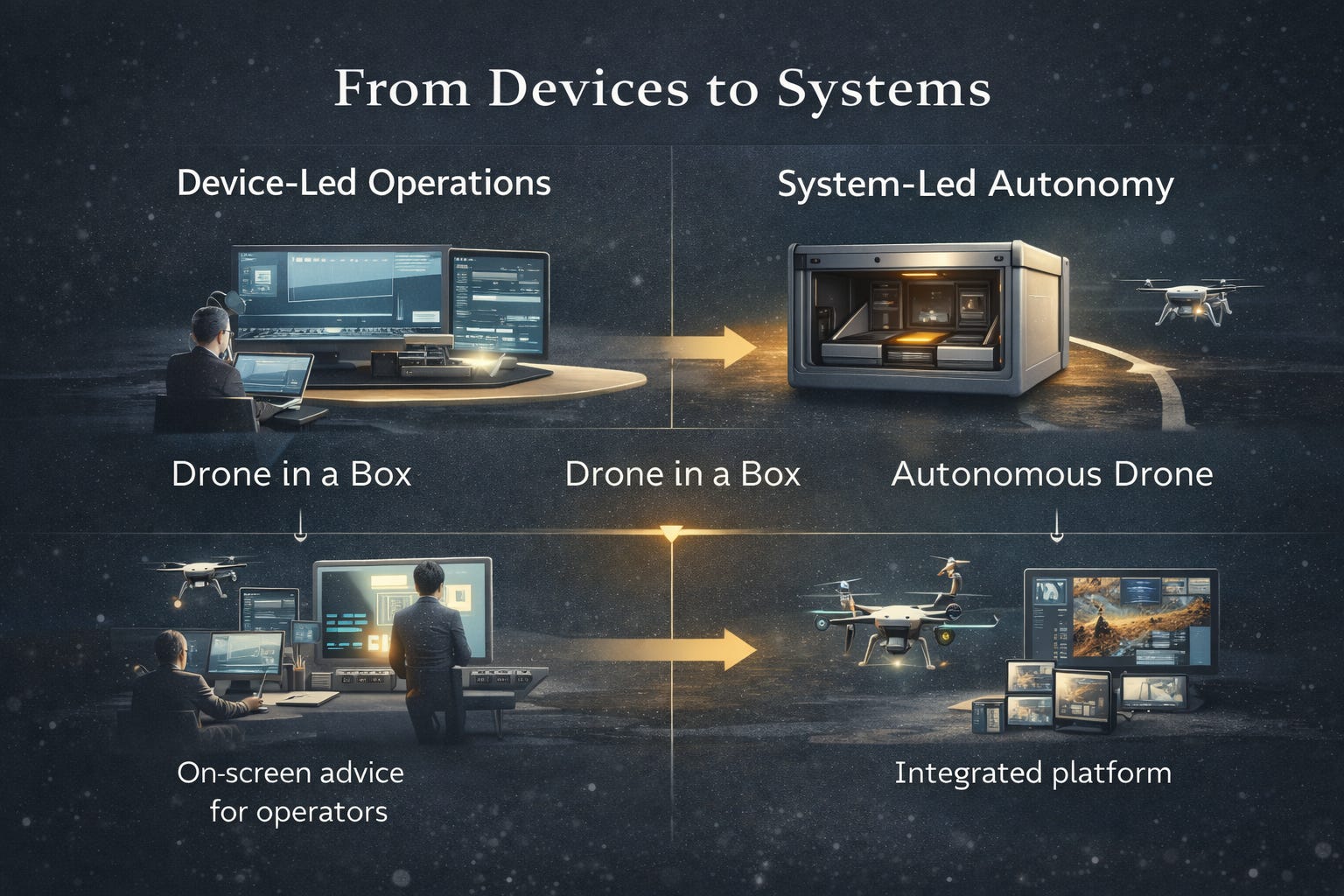
One of the clearest examples of this shift is the Drone in a Box model. By Drone in a Box, I mean a fixed on site docking system where a drone can automatically launch, execute a mission, recharge, and redeploy without a human pilot present.
Instead of manually flying drones, enterprises supervise outcomes. Missions are scheduled or triggered by events.
What matters here is not the drone itself. The real value sits in the orchestration layer that manages autonomy, permissions, workflows, and integrations.
Platforms like FlytBase operate in this layer, alongside broader autonomy and robotics efforts from Skydio, DJI, Boston Dynamics, and ABB.
What enterprises are really buying is continuous capability. One operator can oversee many sites. One control center can manage hundreds of autonomous missions.
If autonomy became continuous inside your operations tomorrow, what would break first: process, governance, or trust?
Enterprise Case Vignette
Consider a large energy utility operating remote substations.
Earlier, inspections were periodic. Crews traveled long distances. Issues were discovered late. Safety risks were constant.
After deploying autonomous inspection drones on site, inspections became continuous. Drones launched daily, captured visual and thermal data, and fed it directly into maintenance systems. Anomalies were flagged early. Crews were dispatched only when intervention was needed.
The outcome was not just cost savings. Uptime improved. Emergency visits reduced. Safety incidents dropped. The workflow changed, not just the tool.
Quiet signal:
Most Physical AI value comes from changing cadence, not adding features.
How Physical AI Expands Its Orbit Inside Enterprises
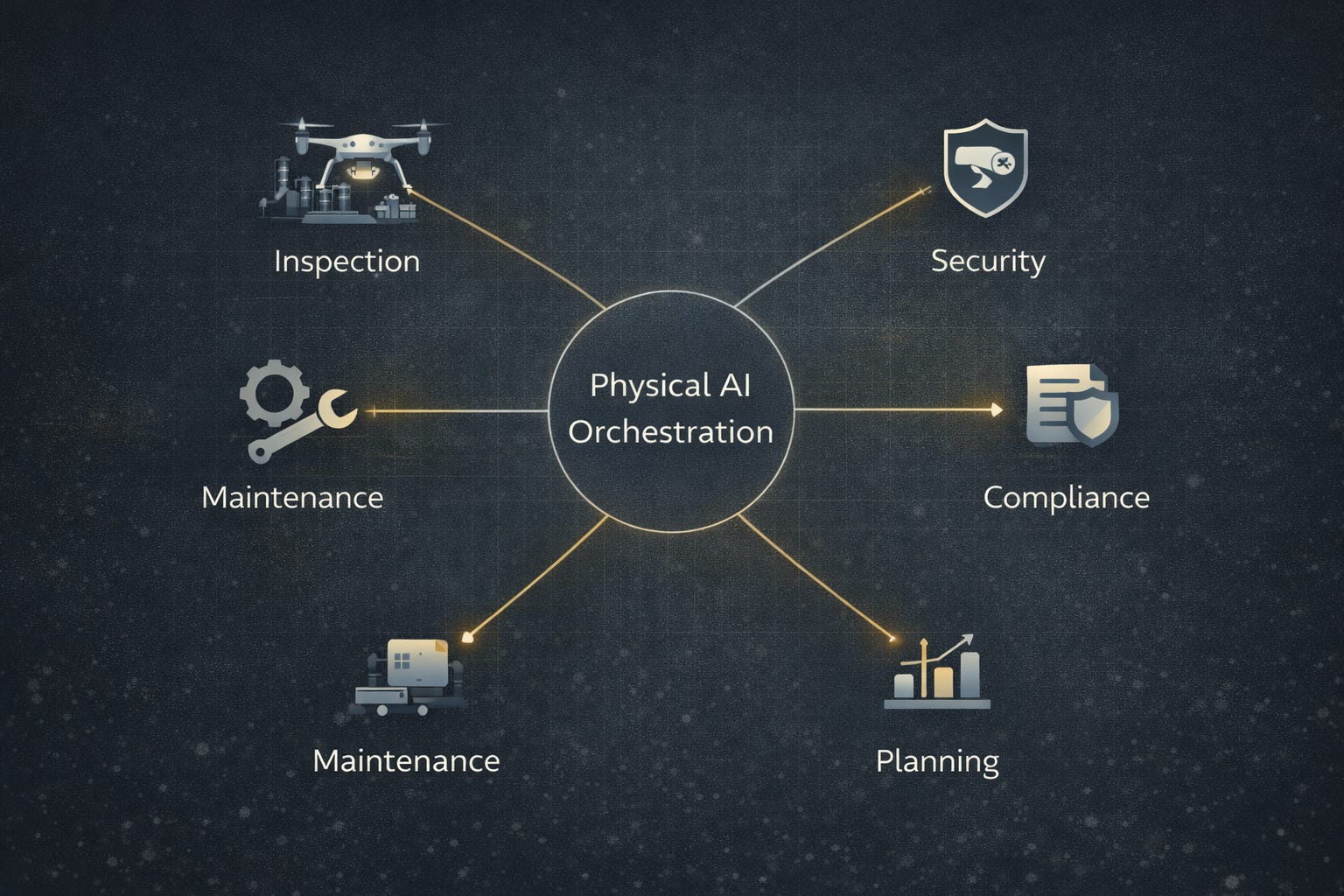
What stands out to me is how Physical AI rarely stays confined to one function.
Inspection data feeds asset management systems.
Visual records support compliance and insurance audits.
Live feeds connect with security operations.
Historical data informs planning and capital decisions.
Once deployed, Physical AI expands its orbit across operations. It becomes part of how organizations observe and manage the physical world.
If this data already existed inside your organization, where would it create the most leverage?
Business Use Cases Enterprises Are Paying For
The strongest use cases today are practical:
Continuous inspection of critical infrastructure
Reduced human exposure in hazardous environments
Night patrols for warehouses and industrial sites
Faster incident response with real time visibility
Lower downtime through early fault detection
These are problems enterprises already budget for. Physical AI changes how efficiently they are addressed.
Where Physical AI Is Scaling First
Adoption is uneven and driven by operational need.
United States due to energy, defense, logistics, and private infrastructure
Australia driven by mining and remote asset inspection
United Arab Emirates through smart infrastructure and state-backed programs
India with long-term pull from utilities, logistics, and infrastructure buildout
European Union through safety and compliance-led adoption
Each region shares one thing. Physical AI addresses problems that are expensive to ignore.
US → Efficiency at scale
Australia → Distance and resource optimization
UAE → Infrastructure intelligence
India → System-level buildout
EU → Regulation-driven deployment
Organizational and Governance Implications
Physical AI is not only a technology decision.
Enterprises must clearly define:
When humans intervene
How escalation works
Who is accountable when autonomy fails
How actions are logged and audited
Trust has to be designed into workflows. It cannot be assumed.
Leadership question:
If autonomy scaled across all your sites tomorrow, would your governance model keep up?
Epilogue
We spent years teaching machines how to analyze information. Now we are asking them to act in the physical world.
That changes the conversation from performance to responsibility. Physical AI will not replace human judgment, but it will force leaders to decide where autonomy belongs and where it does not.
If AI is still only a dashboard inside your organization, you may be missing what is already happening on factory floors, energy sites, and infrastructure corridors.
I am genuinely curious how others are approaching this shift.
Tech Glossary
Physical AI: Autonomous systems that sense, decide, and act in the real world
Edge intelligence: Decision making close to where data is generated
Drone in a Box: Autonomous drone system with on site docking and self operation
Orchestration layer: Software that manages missions, permissions, and integrations
If this piece helped you think beyond AI on screens, you may want to explore more work from Beyond Coordinates.
Original human-authored work, reviewed using RADAR and GLTR analysis.
© Beyond Coordinates, 2026. All rights reserved.