

Operation Trishul 2025 -Rewiring of India’s Defense Mindset
What looked like a drill was actually a reset. For twelve days, India’s forces stopped competing and started thinking as one.

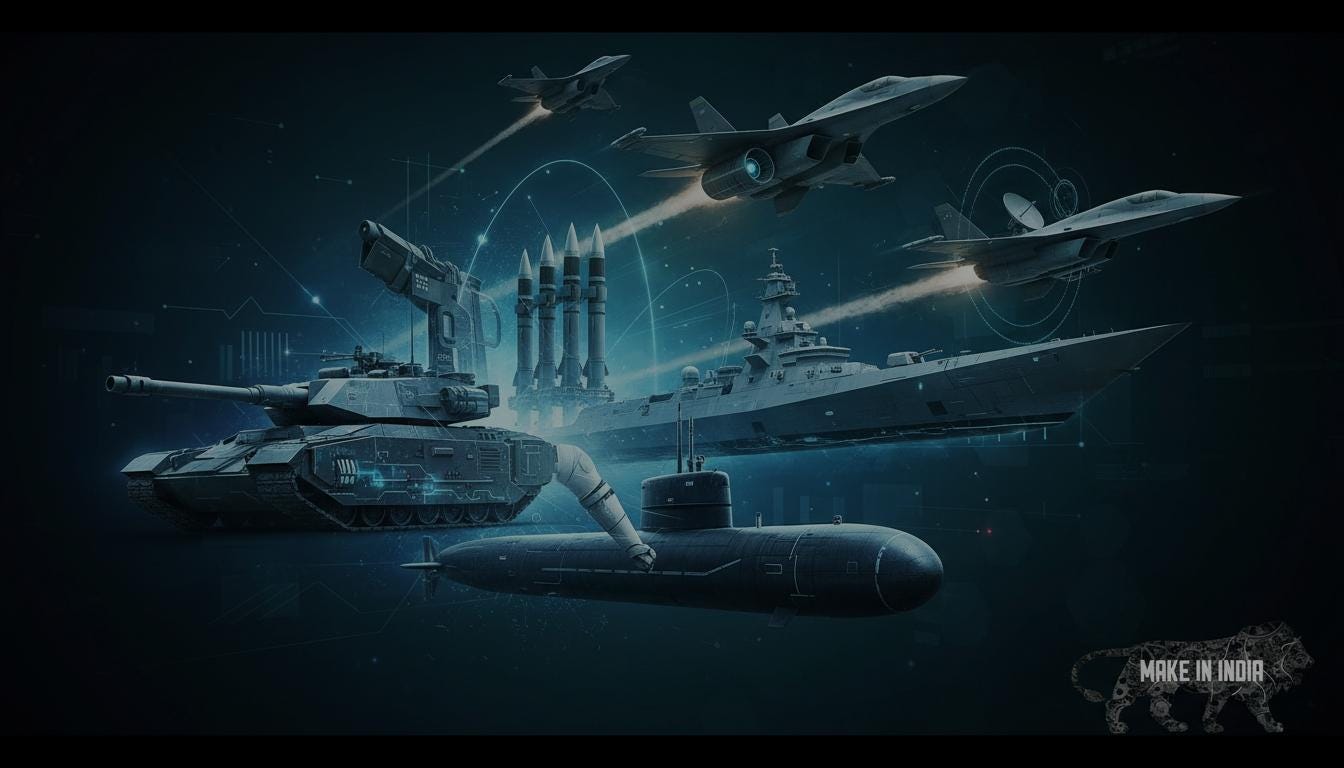
Dispatches | By Beyond Coordinates
Δ ▽ ⧋
Teaser
It looked like a military drill. It was, in truth, a systems rehearsal.
Operation Trishul 2025 became the first moment India’s Army, Navy, and Air Force began acting—and thinking—as one organism.
Behind the noise of maneuvers lay something subtler: a blueprint for self-reliance, cognition, and coherence.
This edition of Dispatches traces how a 12-day operation turned into a test of awareness — and the quiet architecture of a smarter nation in motion.
The Prelude
In the pale dawn over Sir Creek, November 2025 began with the roar of engines and the hum of data.
Operation Trishul—India’s largest tri-service exercise—spanned Gujarat’s creeks, Rajasthan’s dunes, and the northern Arabian Sea.
More than 50,000 personnel from the Army, Navy, Air Force, Coast Guard, and BSF moved in synchronized precision.
I believe Trishul was never about spectacle.
It was about synchronization — India’s first rehearsal of how command, code, and cognition converge.
Comparable to the U.S. Project Convergence and China’s Joint Sword 2024, it marked India’s quiet entry into the age of systemic deterrence — where awareness becomes armor.
The Indian Army’s Unyielding Forge
Across 400 kilometers of frontier, over 25,000 troops rehearsed rapid ingress and sustainment in denied terrain.
100 + armored platforms (T-90 Bhishma & Arjun Mk-1A) crossed 100 kilometers of tidal terrain on indigenous bridges.
K9 Vajra-T artillery synchronized with IAF strikes, closing sensor-to-shooter loops within 60 seconds.
Swarm drones destroyed simulated convoys 15 kilometers out.
I observed a shift—from positional defense to mobile, data-driven warfare, a 40 percent faster response than pre-Sindoor benchmarks.
Trishul wasn’t a show of strength; it was proof that readiness can be engineered.
The Indian Navy’s Tidal Surge
Twenty-five warships, led by INS Jalashwa, turned the western coast into an amphitheater of coordination.
INS Jalashwa off-loaded 1,200 troops and 60 vehicles in 18 minutes.
P-8I Poseidons and INS Kalvari achieved 95 percent accuracy in ASW drills.
MiG-29K sorties exceeded plans by 120 percent under EW jamming.
I believe the Navy’s pivot from blue-water posture to brown-water readiness mirrors India’s economic geography — protecting the maritime corridor that carries ≈ 70 percent of national trade.
It’s defense by design: protection as continuity.
The Indian Air Force’s Celestial Command
Rafales and Su-30 MKIs flew high-tempo missions achieving 94 percent kill ratios and 45-second decision loops.
Over 30 UAVs maintained 24-hour ISR coverage; IL-78 refuelers extended sorties to 14 hours.
I foresee the Air Force becoming India’s first cognitive service — where data replaces delay and fused sensors replace hierarchy.
Tomorrow’s airspace will not just be protected; it will be predictive.
New Technologies — Indigenous Innovations in Action
Approximately 75 percent of Trishul’s systems were home-grown — a living model of Aatmanirbhar Bharat.
Drone swarms of 500 units with 92 percent mission success.
Akashteer anti-drone grids achieving complete airspace denial.
GSAT-7A satellite links syncing BrahMos-NG launchers in real time.
Logistics drones cutting resupply times by half.
I think India’s innovation model is frugality meets functionality — ingenuity shaped by constraint.
Comparative Landscape — India, U.S., and China
Every major power is rehearsing the future of conflict differently.
The U.S., through Project Convergence, is fusing AI-driven command loops at a cost of over $1.2 billion annually.
China, through Joint Sword 2024, is testing quantum-secure communications and full-spectrum PLA integration.
India, through Operation Trishul 2025, achieved 75% indigenous integration for under $0.1 billion, making it the most cost-efficient cognitive coordination exercise in the world.
I believe this is where India stands apart — not in scale, but in synchrony. Others expand through budgets; India advances through balance.
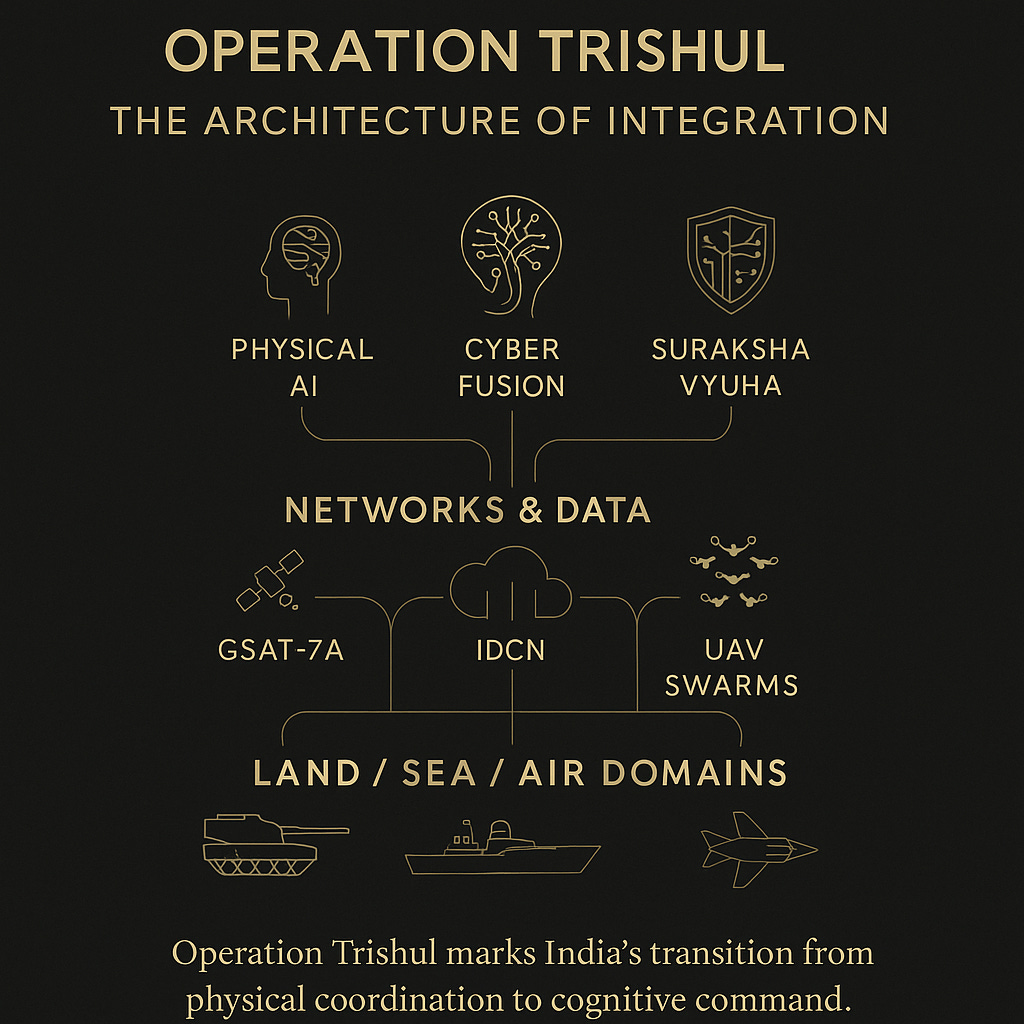
Infographic | Operation Trishul: The Architecture of Integration
India’s transition from physical coordination to cognitive command — linking land, sea, air, and AI.
Joint Operations — The Synergistic Trident
Army tanks rolling off naval decks under Rafale cover.
Drones marking targets for Akash missiles.
Shared command feeds linking sea, land, and sky.
To me, this was India’s first cognitive rehearsal — humans and algorithms co-thinking in real time.
Overall readiness rose 35 percent, validating theater-command integration.
Western Media Perspectives
Outlets like Asia Times and Al Jazeera called Trishul “provocative.”
I feel the Western lens still views India through volatility, not evolution — mistaking preparedness for provocation.
In truth, Trishul was a transparency exercise, not an escalation.
Indian Think Tanks and Strategic Circles
Analysts at ORF and VIF described Trishul as strategic hygiene — a routine validation for two-front readiness.
Open NOTAMs and observer invites signaled intent over aggression.
I believe the next contest will be narrative-driven — fought in media and information ecosystems more than on borders.
Owning the story is now as critical as owning the strategy.
The Road to Aatmanirbhar Bharat (2025 → 2035)
India’s path to self-reliance is visible in numbers:
Defense exports rose from $1.6 billion (2020) → $2.6 billion (2024).
Domestic production share passed 55 percent; target 60 + by 2030.
MRO ecosystem growing 18 percent YoY.
400 + start-ups now active in drones and EW tech.
I think Trishul is the first node in this trajectory — where doctrine, data, and design finally meet.
Yet the path ahead is crowded with non-military resistance — information lobbies, policy inertia, and competing narratives that dilute momentum.
I foresee the next decade as India’s test not of firepower, but of follow-through.
The Challenges Ahead
The obstacles are not only technical but psychological and informational:
Legacy procurement lobbies and opaque arms ecosystems still slow reform.
Sections of NGO and media networks — some with foreign influence — often distort narratives around self-reliance.
Urban ideological movements and digital echo chambers can magnify division and doubt.
These aren’t enemies; they’re noise signals that India must learn to filter if its systemic clarity is to endure.
Bonus — The Next Frontier: Satellites, Physical AI, and the New Shield
Beyond Trishul, India is building a defense architecture that extends into the sky and the cloud:
NavIC Gen-2 satellites now link ISR feeds with low-latency command loops.
Physical AI systems — autonomous UAVs and mobile response bots — are under testing by DRDO and start-ups.
An indigenous multi-layer interception network, nicknamed Suraksha Vyuha, is emerging — a system of radar-integrated missile batteries expected to outperform Iron Dome metrics in range and adaptability.
Together these initiatives outline a future where space assets, AI, and autonomous defense grids form a living ecosystem of protection.
At the same time, the global demand curve is tilting toward India:
Vietnam ordering coastal radars and missiles, Armenia procuring artillery systems, the Philippines and African partners seeking low-cost fighter MRO and drone exports.
Every contract adds a pixel to the image of India as a reliable industrial power for the Global South.
I foresee this as India’s next inflection point — where its industrial supply chains become its strategic currency.
Conclusion — A Trident Tempered for Turbulence
Operation Trishul proved that modern strength is no longer about volume of force but velocity of coordination. I feel deterrence today is not the absence of fear, but the presence of coherence — the ability to sense, decide, and act as one organism.
As India learns to synchronize its three energies — land, sea, and sky — it writes a new grammar of strategic autonomy.
And while outside observers still see escalation, what unfolds is equilibrium through awareness.
The trident gleams — not to strike, but to steady the hand that holds it.
Sources
Asia Times (2025) • Deccan Herald (2025) • Firstpost (2025) • GKToday (2025) • India Today (2025) • Indian Express (2025) • The Hindu (2025) • ORF (2024) • VIF (2017) • IDSA (2021) • Moneycontrol (2025) • Reflections (2025) • Zee News (2025) • The Statesman (2025) • Times of India (2025)
© Beyond Coordinates 2025
All rights reserved.