
The BioQuantum Lab | Expanding Orbit 02
Life ↔ Computation ↔ Design — Where intelligence begins to grow like life itself.

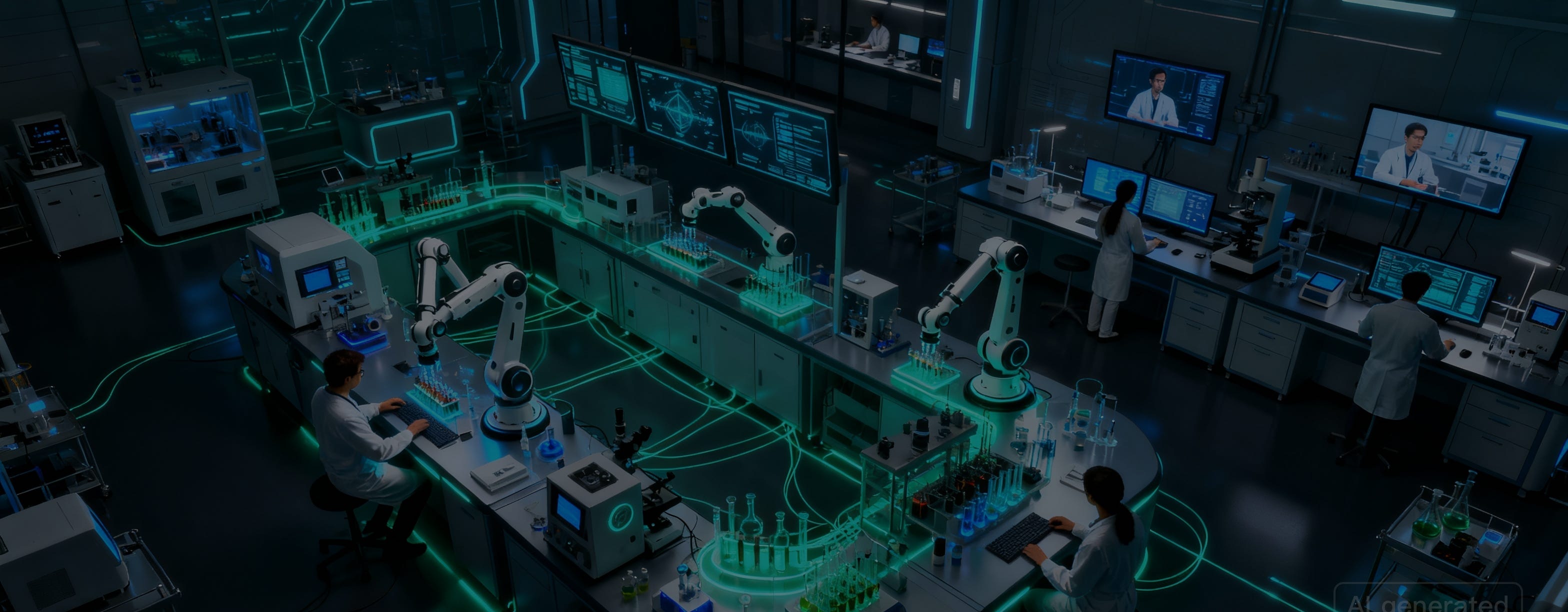
Every discovery begins as a signal in search of sense. I believe the next generation of laboratories won’t just analyse data , they’ll learn to listen.
The BioQuantum Lab is that threshold — where biology and computation start to share the same heartbeat.
The Expanding Orbit | By Beyond Coordinates
Δ ▽ ⧋
The New Axis of Creation
I think we’ve entered a quiet but irreversible shift in how discovery happens.
Biology and computation no longer evolve on parallel tracks , they now share a pulse.
From CRISPR to digital-twin simulations, from organ-on-chip systems to AI-designed molecules, I believe research has begun to design the very conditions of awareness.
The laboratory is no longer a location; it’s becoming a living network that thinks, senses, and remembers.
The Symbiosis of Systems
Three architectures now converge beneath every experiment:
Genomic Intelligence — interpreting context, not just code.
Neural Simulation — digital cognition that tests before touching.
Bio-Synthetic Fabrication — materials and cells that self-assemble and heal.
I feel this is the first time machines behave biologically while biology learns to compute.
When that happens, discovery stops being an event — it becomes a conversation.
The BioQuantum Architecture — Micro-Ecosystems in Motion
The BioQuantum Lab is not a facility; it’s an ecosystem of ecosystems where each domain acts as a neural layer of the same living system.
Digital Lab Management → From Records to Relationships
Modern LIMS and ELNs are becoming the nervous system of scientific interoperability — translating between machines, algorithms, and human care systems. They don’t just store data; they learn from it.
- A global vaccine program updates instantly across three continents.
Automation & Robotics → From Precision to Prediction
Robots now design and optimize experiments autonomously.
- A biofoundry uses AI-driven liquid handlers that adjust ratios overnight for maximum yield.
Advanced Instrumentation → From Observation to Awareness
IoT sensors merge environmental and human feedback.
- A neurosensory lab slows equipment when researchers’ stress levels peak.
Cybersecurity & Data Integrity → From Storage to Trust
Blockchain creates an ethical memory for science itself.
- A genomics startup verifies every protein synthesis through cryptographic hashes.
Cloud & Edge Computing → From Infrastructure to Immediacy
Edge AI lets teams run experiments as if they share a single lab.
- Researchers simulate viral mutations on distributed servers in real time.
Connectivity & Networks → From Devices to Ecosystems
5G/6G telepresence makes collaboration instant.
- A scientist in Zurich controls a quantum microscope in Bangalore with no latency.
Bioinformatics & Computational Labs → From Data to Design
AI and quantum models turn genetic information into living blueprints.
- A startup designs enzymes for carbon capture using generative AI.
Together, these threads form what I call the BioQuantum Continuum — a research organism that learns, evolves, and remembers.
Global Adoption and Market Pulse
The smart-lab market is expanding ≈ 12–14 % CAGR (2024–2032).
I see five regions defining its tempo:
United States — deep AI automation and bio-compute integration.
Germany / EU Bloc — ethical automation and Green Labs frameworks.
China — state-backed bio-manufacturing and robotic parks.
Japan — human-robot synergy and quantum instrumentation.
India — fastest growth (15 %) via affordable AI-genomics and open innovation.
I believe scientific leadership will soon depend less on scale and more on interoperability and trust.
The Transition → From Traditional Labs to The BioQuantum Lab
I see six measurable shifts redefining the laboratory cycle:
Static Samples → Smart Samples tagged and block-verified.
Human Control → AI Guidance in design and execution.
Linear Workflows → Live Simulations through digital twins.
Post-Run Analysis → Real-Time Insight via edge AI.
Manual QC → Autonomous Verification with AI audit chains.
Static Reports → Living Knowledge Graphs that self-update.
These transitions shorten cycle times by over 60 % and turn knowledge into a living feedback loop.
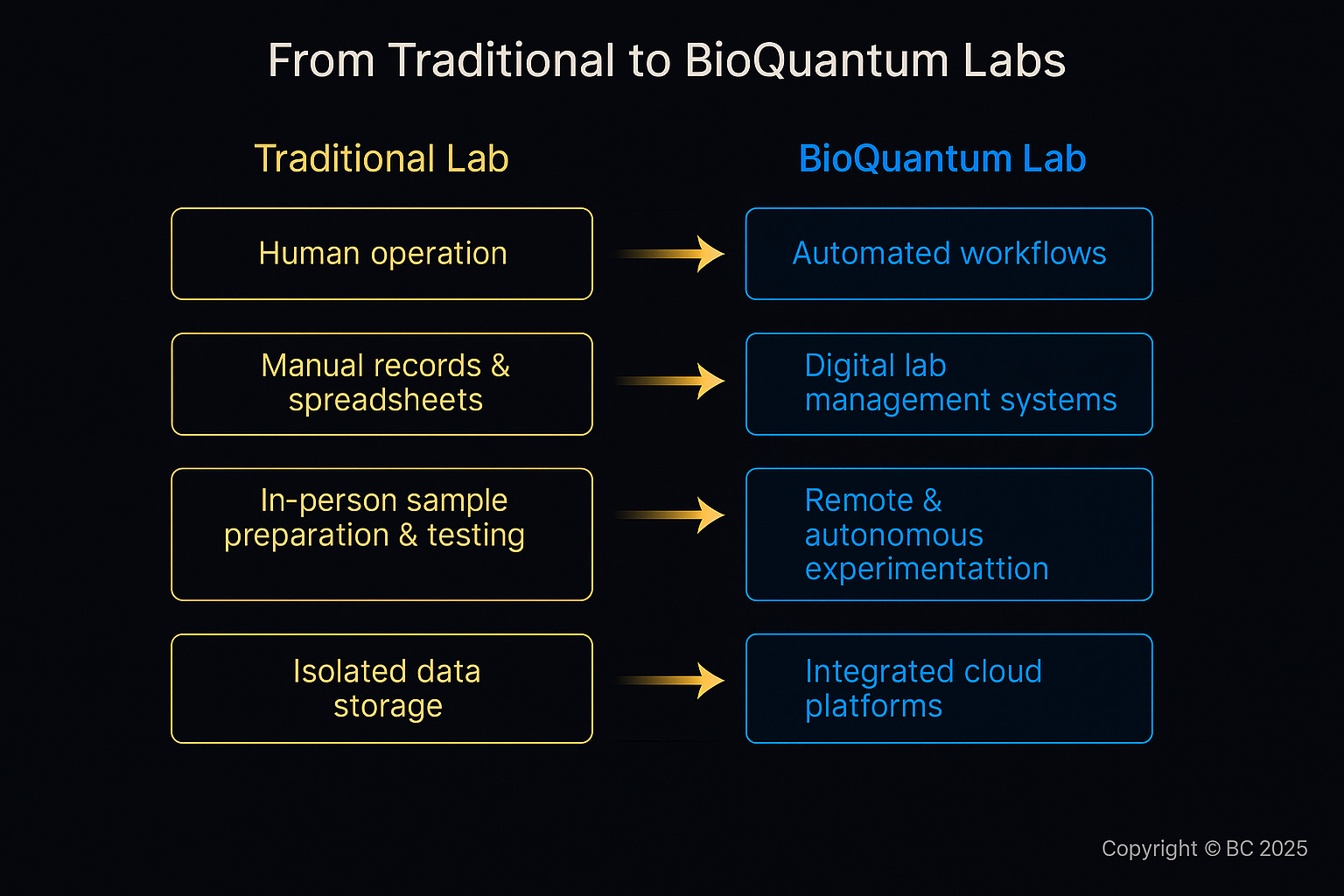
Every transformation begins with a translation — from human control to guided intelligence, from static data to living knowledge. The BioQuantum Continuum isn’t just faster; it remembers.
The Connective Layer — Integrators and Enablers
I think the BioQuantum ecosystem is as much about connection as creation.
System Integrators (SIs) → from implementing LIMS to architecting modular bio-digital ecosystems.
Independent Software Vendors (ISVs) → from point tools to AI-driven lab orchestration platforms.
Hardware Integrators → analytical devices with AI co-processors and self-diagnostics.
TMT & 5G Networks → telepresence and real-time edge analytics as default.
Cloud & Cybersecurity Firms → from defense to trust layers ensuring data lineage and transparency.
I see these actors forming the connective tissue of scientific intelligence.
Business Frontiers and Future Vectors
LabTech as Infrastructure → AI + Robotics + Edge as turnkey environments.
Cognitive Cloud Networks → high-throughput bio-research clouds.
Zero-Touch Instrumentation → self-analysing, self-reporting devices.
5G/6G Research Grids → real-time remote experimentation.
Ethical Traceability Platforms → AI + Blockchain verifying scientific truth.
Each vector moves science toward responsible autonomy — speed with awareness.
The System of Interdependence
If Industry 4.0 taught machines to think faster, Industry 5.0 and the BioQuantum paradigm will teach them to think together.
AI will guide the experiment.
Cloud will preserve memory.
Edge will deliver immediacy.
5G will connect presence.
Security will guard truth.
And beneath it all, the human mind will remain the conductor.
We’re not building smarter machines anymore; we’re teaching intelligence to grow like life itself.
The Human Integration Layer — From Systems to Outcomes
I believe the next leap for BioQuantum systems is how they connect science to care.
The same logic that links robots, clouds, and LIMS will soon link laboratories to EHRs and clinical ecosystems.
In value-based care, success will be measured not by how much treatment is given but by how intelligently data moves — between lab, doctor, patient, and policy.
I see interoperability becoming the invisible currency of trust.
Next-generation LIMS will merge with EHRs to create living continuums of knowledge — research feeding care, care feeding research.
I feel this is where science stops being a system and starts becoming a service to life itself.
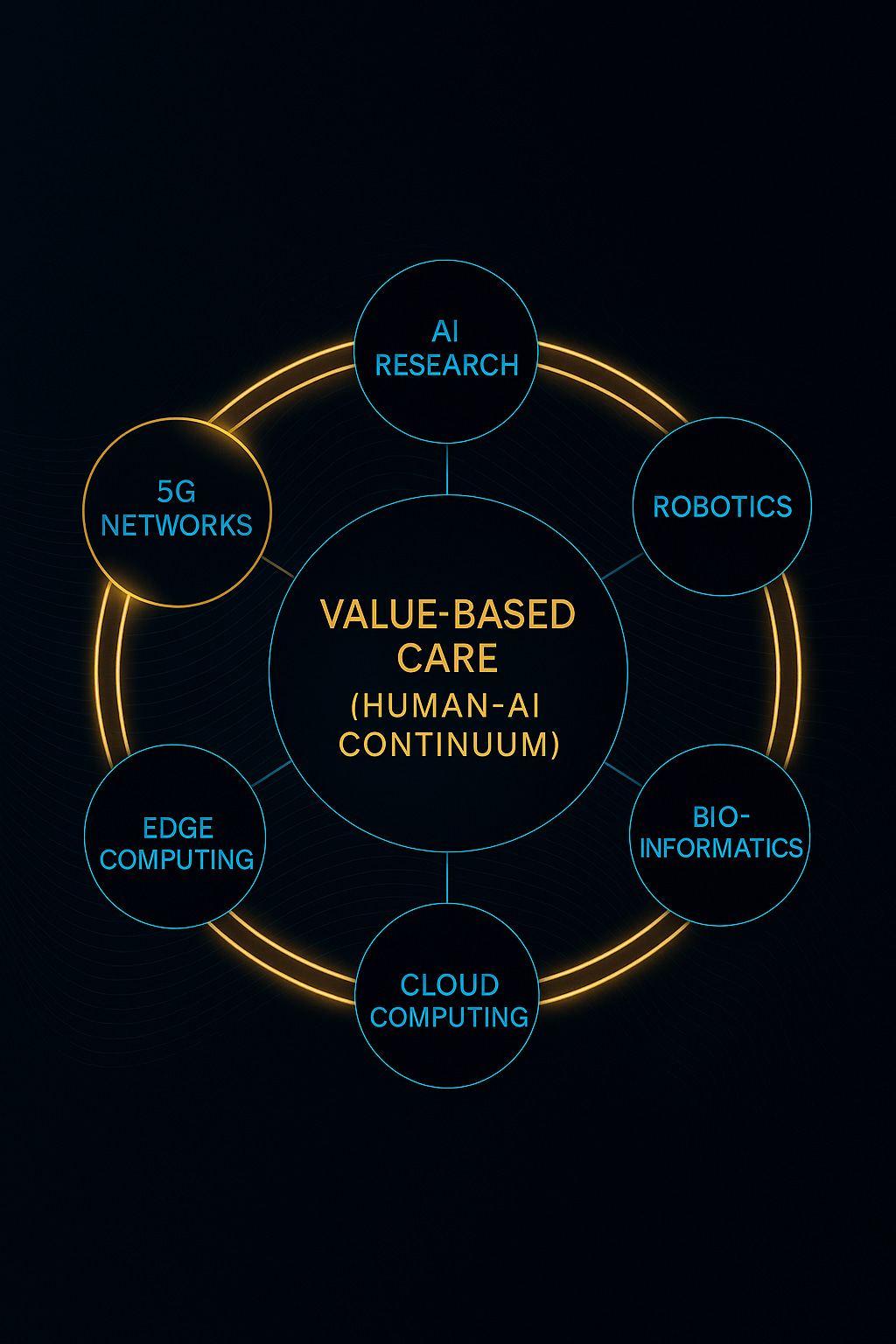
All intelligence is relational. Every system in the BioQuantum Lab — from cloud to care — learns through connection. This is the living architecture of tomorrow’s science.
The Ethical Mirror
The closer we get to editing life, the more we must earn the right to do so.
Our true challenge won’t be speed or scale; it will be humility — teaching autonomous systems when to pause.
I believe the most advanced form of intelligence will be empathy coded into decision-making.
The BioQuantum Outlook
By 2030, the most valuable labs won’t own the largest buildings — they’ll own the clearest feedback loops.
Research will shift from publishing results to publishing living intelligence.
I see a world where biology becomes a medium for computing and computation becomes a mirror for life.
We’re not just decoding life anymore. We’re designing intelligence — ethically, organically, and continuously.
Sources
DeepMind (2024) – AlphaFold Structural Biology Reports
NVIDIA (2025) – BioNeMo AI for Protein Design
EU Human Brain Project (2024) – Ethical Frameworks in Computational Neuroscience
IISc & IIT Madras (2025) – Digital Cell Behavior Modeling Summaries
WEF (2025) – Smart & Automated Lab Market Outlook
Δ ▽ ⧋ | © Beyond Coordinates 2025
Part of The Expanding Orbit series — mapping how life, computation, and design begin to co-evolve.