

Agentic CRM and Customer Systems
How AI Agents and Workflow Automation Are Reshaping Enterprise CRM Systems


△ ▽ ⧋
Cognitive Index | By Beyond Coordinates
Functional Cognition 02
Readers Note
This piece explores how AI agents, workflow automation, and modular CRM ecosystems are beginning to reshape enterprise customer operations across sales, RevOps, manufacturing, and regulated industries.
Especially relevant for:
• RevOps and Sales Operations leaders
• CRM and Enterprise Architects
• Customer Success and CX strategists
• SaaS founders building AI-first workflows
• Manufacturing and operational transformation teams
• Pharma and compliance workflow professionals
Part of the Functional Cognition series under Beyond Coordinates.
Traditional CRM systems helped companies centralize customer data, manage pipelines, and standardize sales operations. Over time, many enterprise CRM deployments also became operationally heavy with fragmented workflows, admin dependency, and increasing customization complexity.
That model is now changing.
A new generation of AI CRM platforms, workflow automation tools, and modular customer systems is reshaping how organizations manage sales, RevOps, customer success, and operational coordination. Instead of functioning only as systems of record, CRM platforms are gradually evolving into systems capable of workflow execution, contextual automation, and AI-assisted coordination.
From the Functional Cognition Series
This piece builds on FC 01, which explored how enterprise systems are evolving from static operational platforms toward more adaptive and intelligence-driven architectures.
Related Reading:
Functional Cognition in Enterprise Systems: How AI Is Changing RevOps, CRM, and Decision Making
Why Traditional CRM Systems Are Facing Fatigue
Many organizations still rely heavily on enterprise CRM platforms, but operational inefficiencies are becoming more visible across teams.
Common challenges include:
Manual updates across multiple systems
Low CRM adoption among operational users
Fragmented customer context
Heavy admin and consulting dependency
Reporting complexity with limited workflow intelligence
Slow deployment and customization cycles
Traditional CRM systems were built to centralize customer information and standardize workflows. They still do that well. The problem is that most operational teams now expect much more from them.
This gap is creating demand for more adaptive customer systems.
Systems of Record vs Systems of Action
Traditional CRM platforms mainly focus on:
Contact and account management
Pipeline tracking
Activity logging
Forecasting and reporting
Modern AI-driven customer systems are expanding beyond those functions.
Emerging workflow-native CRM environments increasingly support:
AI-generated follow-up actions
Automated lead qualification
Workflow orchestration across departments
Context-aware task prioritization
Automated CRM updates
AI-assisted customer summaries
The operational focus is shifting from storing customer information toward continuously acting on customer context.
Rise of DIY CRM and Workflow-Native Platforms
One of the biggest shifts in the CRM ecosystem is the rise of modular and DIY CRM environments.
Startups, SMBs, RevOps teams, and enterprise departments are increasingly assembling lightweight customer systems using AI agents, workflow automation platforms, low-code tools, and composable software stacks.
Traditional CRM platforms such as Salesforce, HubSpot, and Zoho CRM continue to dominate enterprise adoption, but workflow-native ecosystems are creating alternative operating models.
Platforms such as SuperAGI, Clay, Attio, n8n, and Retool are enabling faster customization, modular workflows, and AI-assisted operational execution.
Traditional CRM Platforms
Centralized architecture
Standardized workflows
Higher admin dependency
Longer deployment cycles
DIY and AI-Native CRM Systems
Modular workflows
Faster customization
Workflow-first architecture
AI-assisted execution
Context-aware automation
Companies are increasingly designing CRM workflows around operational needs instead of adapting operations around rigid software structures.
The Agentic CRM Ecosystem
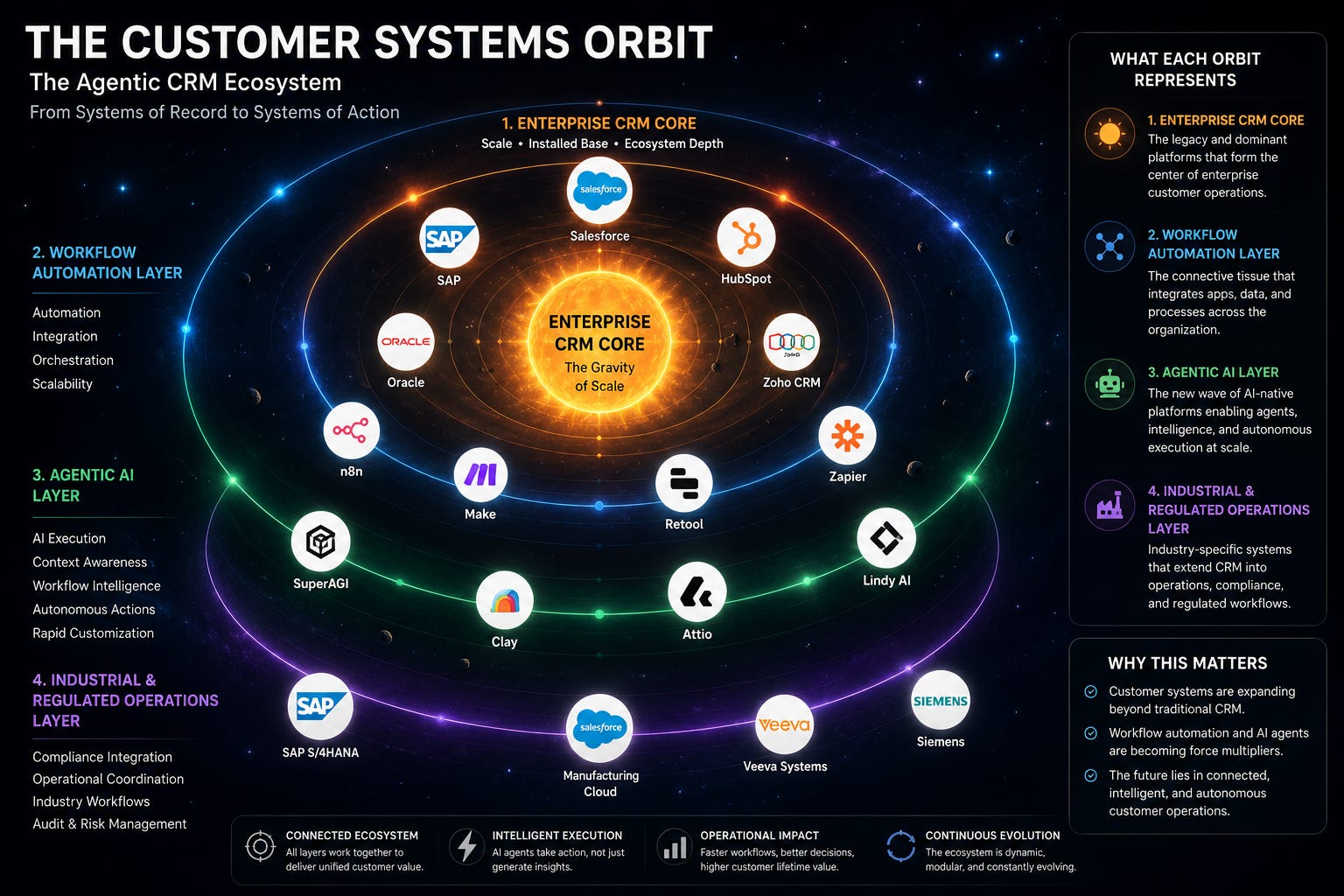
The Customer Systems Orbit
Orbit Layers:
Enterprise CRM Core
Workflow Automation Layer
Agentic AI Layer
Industrial and Regulated Operations Layer
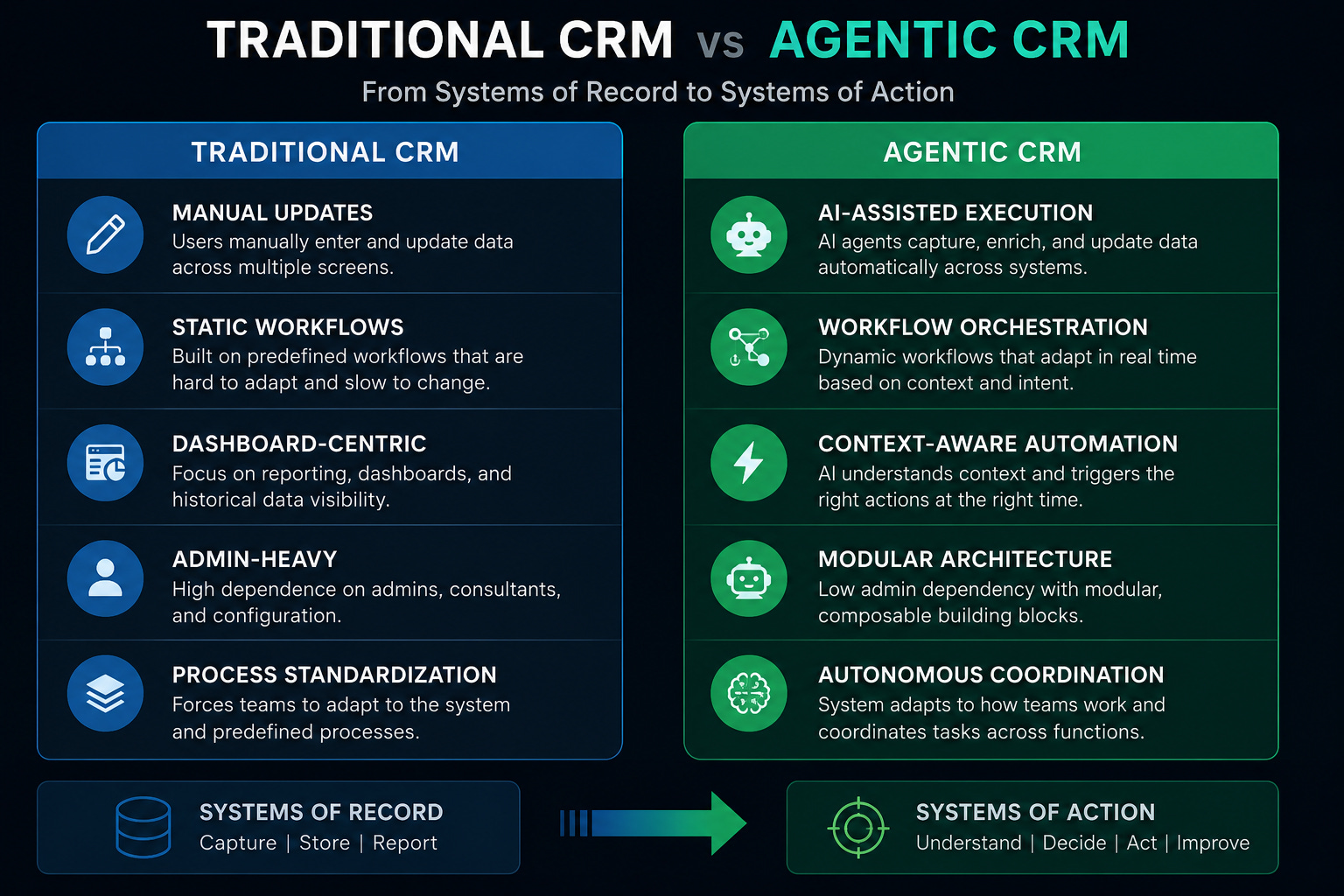
Traditional CRM VS Agentic CRM
CRM Expansion Into Industrial and Regulated Operations
The transition toward AI-assisted customer systems is also becoming visible across manufacturing, industrial operations, and regulated sectors.
Platforms such as SAP S/4HANA, Salesforce Manufacturing Cloud, and Veeva Systems highlight how CRM, compliance workflows, operational intelligence, and customer operations are becoming more connected across enterprise environments.
Operational Impact Snapshot
Startup and SMB Ecosystems
Faster CRM deployment
Lower implementation overhead
Flexible workflow customization
AI-assisted sales and customer operations
Mid-Market and Enterprise Teams
Workflow orchestration across departments
RevOps and customer success alignment
Reduced manual coordination
Better operational visibility across customer systems
Regulated and Industrial Operations
Compliance workflow integration
Service and operational coordination
Audit readiness support
Connected customer and operational intelligence
Industry Adoption Trends
SaaS and Technology
Using AI CRM systems to automate lead workflows, customer engagement, and RevOps operations.
Manufacturing and Industrial Operations
Connecting CRM platforms with production visibility, service workflows, and operational coordination.
Pharma and Life Sciences
Expanding workflow automation across compliance operations, RIM coordination, and customer management.
Financial Services and B2B Services
Improving client lifecycle management, workflow visibility, and AI-assisted engagement operations.
Concluding Thoughts
CRM platforms are evolving beyond customer record management.
AI agents, workflow automation, and modular software ecosystems are reducing operational friction across customer operations, RevOps, and enterprise workflows. At the same time, DIY CRM environments and workflow-native architectures are making customer systems more flexible, customizable, and execution-oriented.
The next phase of CRM will likely be shaped by workflow intelligence, contextual automation, AI-assisted coordination, and operational automation.
Visual References and Media Credits
Public platform references sourced from official company and product ecosystems mentioned throughout the article.
Visual frameworks and infographic structures conceptualized by Beyond Coordinates.
© Beyond Coordinates 2026
Original analysis, visual systems, and editorial frameworks developed for the Functional Cognition series.